
Court of Petty Appeals: The Estate of E.M. Frimbo v. Andrew Moore
The Estate of E.M. Frimbo
v.
Andrew Moore
79 U.Va 7 (2026)
Koeppel, J., delivers the opinion of the Court, in which Berklich and Wu, C.J.J., and Boatright, Lozada, Lawson, and Vanger J.J. join. Moore, J. concurring in part and dissenting in part.
Koeppel, J., delivers the opinion of the Court.
Before this venerable tribunal is a dispute of the sort that arises only when a man is generously provided a platform to write, and does so without any guidelines or supervision. The Estate of E.M. Frimbo alleges that Defendant Andrew Moore misappropriated E.M. Frimbo’s name and likeness by authoring multiple articles of “Frimbo-Style” shenanigans, and referred to him in multiple unrelated pieces.
The Court has attempted to read the articles. But admittedly can’t understand anything Mr. Moore is attempting to convey.
Facts
The facts are as follows: Andrew Moore is a 2L law student with an unnatural fixation on trains and E.M. Frimbo. On September 2, 2026, the Law Weekly published an article titled 79.1 All Aboard the 156!, in which Mr. Moore recounted his summer experiences in “Frimbo-Style.” Later, in an article titled Listening to Justice Barrett, published on September 23, Mr. Moore invoked E.M. Frimbo’s name and likeness in an article reporting on U.S. Supreme Court Justice Amy Coney Barrett’s visit to UVA. Moore speculated that Justice Barrett may be an E.M. Frimbo by virtue of her enjoyment of train travel. On October 7, Mr. Moore, moonlighting as Justice Moore, in National Association for Equine Equality (NAEE) v. Foxfield, 79 U. Va. 6 (2026), authored an opinion once again invoking E.M. Frimbo’s name and likeness, as support for the equine's meritorious claim against the Foxfield Races. This week, Mr. Moore has published an E.M. Frimbo-style article retelling his fall break endeavours, titled All Aboard the 156! Part Two. For the record, that is four E.M. Frimbo-style or invoking articles in less than 50 days. For context, the most recent non-Andrew Moore-written publication invoking E.M. Frimbo’s identity occurred on September 10, 2019, when Philip Mason of the “Vintage Railway Stations, Round Houses, Locomotives, Coaches, Cabooses of Canada” Facebook group mentioned E.M. Frimbo in a post with five likes and two replies.
What is particularly evident from the facts is that Mr. Moore is obsessed with E.M. Frimbo. But unnatural obsession with a deceased party is not per se misappropriation of the decedent’s name and likeness
It is worth explicating the origins of E.M. Frimbo before advancing to an analysis of the applicable law.
E. M. Frimbo was the alter ego of longtime New Yorker writer and editor Rogers E. M. (Pospie) Whitaker. Frimbo made his first appearance in The New Yorker in the issue of September 22, 1945. E.M. Frimbo would become known as “World’s Greatest Railroad Buff,” having traveled a total mileage of 2,748,674.73 miles by train throughout his life.
Discussion:
“Misappropriation of one's name and likeness for commercial purposes was the first form of invasion of privacy recognized by the courts.” Nat'l Bank of Com. v. Shaklee Corp., 503 F. Supp. 533, 540 (W.D. Tex. 1980), citing Pavesich v. New England Life Ins. Co., 122 Ga. 190 (1905).
To provide a cause of action for misappropriation, a plaintiff must establish that his or her personal identity has been appropriated by the defendant for some advantage, usually of a commercial nature, to the defendant. W. Prosser, The Law of Torts s 117 (4th ed. 1971).
This Court finds National Bank of Commerce v. Shaklee Corp. to be on point and persuasive. In Shaklee Corp., a federal district court found that the use of a famous newspaper columnist's name to imply that columnist's endorsement of the product was a violation of this common-law right. Ms. Heloise Bowles had sued the Shaklee Corporation for damages, alleging misappropriation of her name and likeness, arising out of Shaklee's causing the publication of a special edition of Heloise's book “All Around the House” and of certain advertisements or articles in Shaklee's magazine, the Shaklee Survey. Heloise later died and the executor of her estate, the National Bank of Commerce, was substituted as the plaintiff. Shaklee Corp., 503 F. Supp. 533.
Here, Mr. Moore has caused for publication multiple articles invoking E.M. Frimbo or articles duplicating “Frimbo-Style” for his advantage.
Mr. Moore does not dispute that he has appropriated the personal identity of E.M. Frimbo, but claims he has derived no such advantage from the appropriation as required in a cause of action for misappropriation.
The Estate of E.M. Frimbo asserts that Mr. Moore derives “sick pleasure” from others reading his appropriation of E.M. Frimbo’s name, and that sick pleasure constitutes the requisite advantage for a cause of action for misappropriation.
We now review for evidence of other people reading Mr. Moore’s articles. It is a stretch to say that Mr. Moore’s articles attract great readership. First, 70 Law Weekly online visitors have viewed Mr. Moore’s article titled Listening to Justice Barrett, in which he invoked E.M. Frimbo. 72 Law Weekly online visitors have viewed 79.1 All Aboard the 156!, the article where he first released his “Frimbo-Style” writing. These 142 poor souls’ reading of Mr. Moore’s article alone likely does not constitute an advantage. But Mr. Moore’s articles have also led to a greater than 5,000% increase in searches for Frimbo. See Exhibit A: E.M. Frimbo Interest Over Time.
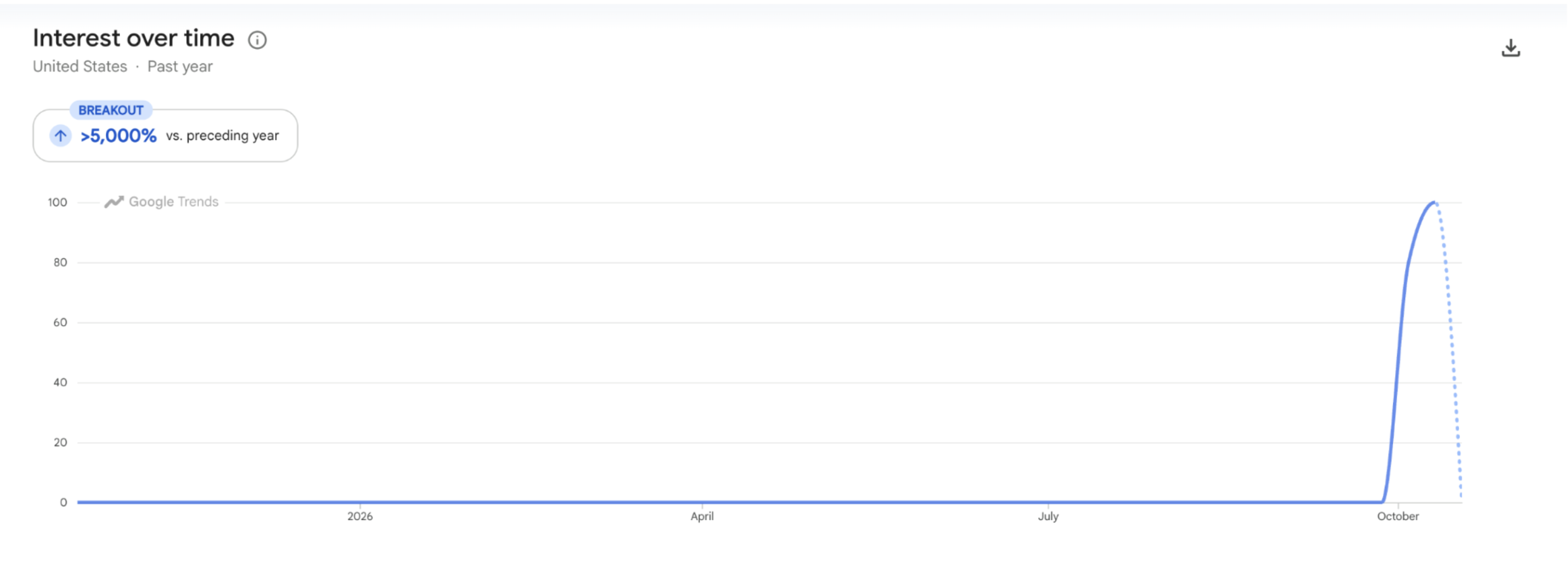
This court makes the logical jump that Mr. Moore has taken pleasure in both others reading his misappropriation of E.M. Frimbo’s name and likeness, and the great growth in global Frimbo interest his articles have caused. This constitutes sufficient advantage to sustain the Estate’s cause of action for misappropriation.
First Amendment Defense:
Mr. Moore contends that E.M. Frimbo is long deceased and is a public figure, and thus his speech is protected under the First Amendment of the Federal Constitution. However, in Zacchini v. Scripps-Howard Broadcasting Co., 433 U.S. 562 (1977), the Supreme Court held that no constitutional privilege existed for a television station's misappropriation of Zacchini's performance as an entertainer. Shaklee Corp., 503 F. Supp. at 540.
Thus, Mr. Moore’s First Amendment defense fails before that Supreme Court precedent.
But it is worth mentioning that E.M. Frimbo likely doesn’t satisfy any public figure exception to the First Amendment since this Court had no idea who he was until searching Locomotive Enthusiast message boards for mentions of E.M. Frimbo.
Order:
The Court therefore finds that Defendant, Mr. Andrew Moore, did misappropriate the name and likeness of E.M. Frimbo, and enters an injunction on behalf of the Estate against future articles invoking E.M. Frimbo or claiming to be “Frimbo-Style.”
Moore, J., dissenting.
The Court’s order in this instance borders on the preposterous and salacious (and is on the wrong side of the border, it might be added). For one, the allegations of commercial gain are sadly misguided, as my current student loan balance can attest. Additionally, the very same authoring justice of this opinion (and it is truly more of an opinion, not in keeping with the analytical certitude for which this court is known) recently authored a more authoritative holding in yestermonth, holding, “today and for eternity that the Court of Petty Appeals possesses sovereign immunity and may not be maliciously defamed.” United States v. Cig Pro, 79 U.Va. 5 (2026) (quoting United States v. Cig Pro, 79 U.Va. 5 (2026) (“today and for eternity that the Court of Petty Appeals possesses sovereign immunity and may not be maliciously defamed”)). Therefore, this justice is hereby immune from this blasphemous heresy.