
What You’d Have Learned If You Had Gone to the Lile Semifinals
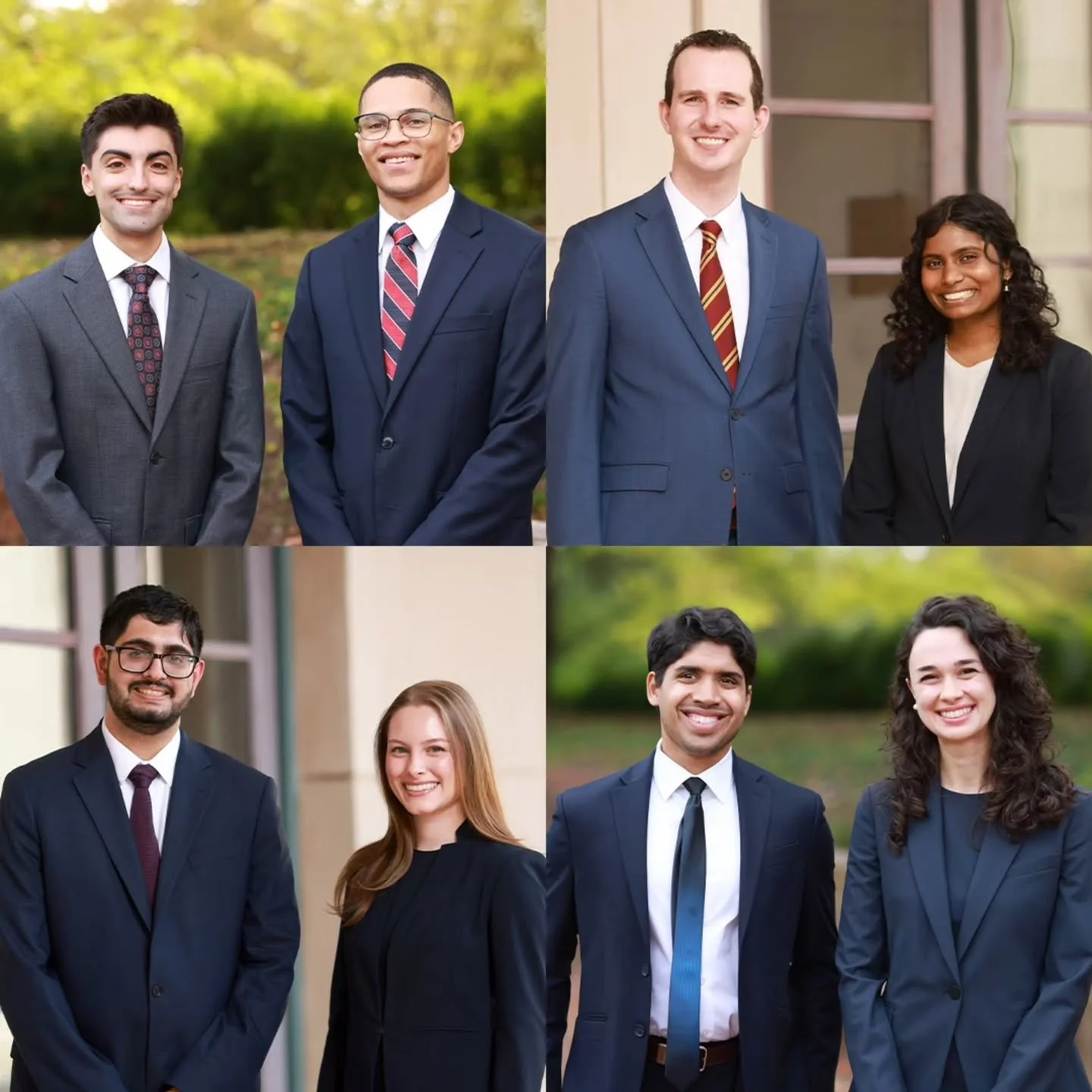
If you had made your way to Caplin Pavilion for the Lile Moot Court Semifinals on the 6th of this month, your primary takeaway would have been a greater and more intimate understanding of what good appellate advocacy is. Shree Balaji ’27 and Dan Cummins ’27 (appellants) faced Jalen Harrison ’27 and Seena Saiedian ’27 (appellees) in the first heat, followed by Caroline Davisson ’27 and Salaar Khan ’27 (appellants) going up against Macy Armagost ’27 and Rohan Menon ’27 (appellees). Facing a bench that swung drastically between hot and cold, each contestant deftly navigated the murky legal territory of this year’s problem. While giving comments following the first oral argument, Judge Daniel E. Ortiz (Col ’99) of the Virginia Court of Appeals—sitting on the judges’ panel alongside Professor Sarah Shalf ’01 and Judge Joshua Deahl of the D.C. Court of Appeals—remarked that the oralists he’d just seen were “better than probably eighty percent of the lawyers who show up in my courtroom.” Professor Shalf lent her vigorous endorsement; she and her colleagues had heard, and disbelieved, the same thing from visiting judges in their mooting days, but these students had better believe it. Among the constructive feedback offered by Judge Deahl was to avoid the temptation to over-rely on precedent, which he compared to a “comfort blanket.” In his view, too many oralists “treat judges as formalists when really they’re more like realists,” and strong arguments are more often based on good reasoning than the mere citing of authority.
Perhaps the second most salient lesson would have been that oral arguments are hard to follow if you aren't familiar with the record. The facts of this year’s problem (somewhat based on those in Salazar v. Paramount Global, recently argued before the Supreme Court) involve a fantasy football advice provider, a newsletter, user data, and the Video Privacy Protection Act. With time, and with the benefit of watching a second oral argument on the same topic, the contours and import of the questions became clearer. When does an internet company become subject to personal jurisdiction? (Side note: one of the authors had this exact question for their CivPro cold call and did NOT appreciate the reminder.) What entitles someone to protections under the VPPA? An understanding of the issues helps to bring clarity to the ideas, but certainly not definiteness to their answers; indeed, they appeared tailor-made to guarantee robust and reasonable arguments and hypotheticals on both sides. The resulting hypos, one of which involved a roadside tire-repair shop that may or may not purposefully avail itself of the states its customers drive to and from, were thorny enough to make the advocates clench the podium more than mere discipline could ordinarily require. And the Act itself does no favors to one trying to interpret it. The VPPA was a response to an episode during Judge Robert Bork’s infamous confirmation hearings: A reporter had the bright idea to look into Bork’s videotape rental history to uncover the secrets of his mind. (Revelatory: Bork loved Cary Grant.) Congress subsequently passed a law protecting consumers from such invasions by prohibiting “videotape service providers” from sharing their consumers’ history, a law that faces some difficulty when applied to our digital world. Shalf asked pointedly whether Congress simply could not have conceived of the modern Internet at the time of the law’s passage. Probably so. Still, the contenders had to do their best to argue that their modern interpretation of an obviously outdated document (that refers to audiovisual content as “video tapes”) was better than the rest, and we mere spectators simply had to do our best to follow along.
If you stuck around after the judges’ deliberations, you’d have found out who won. Balaji and Cummins will face Davisson and Khan for the title on Thursday, November 12, at 4:00 pm in Caplin Auditorium. With both appellant teams triumphing, Balaji and Cummins will remain as appellants in the final round, while Davisson and Khan will flip sides to argue for the appellees. Regardless of the results, there was a very real sense that everybody had won. The mood was jovial in the fifteen-minute recesses the judges spent deliberating after each argument. There were parents, congratulatory gifts, and smiles all around. Classmates hugged and shook hands with the competitors, and unaffiliated spectators sat in awe of the participants. Excited, somewhat nervous chatter filled Caplin as surely as the late afternoon sunglow only slightly dimmed by blinds. One got the sense that whoever lost would be genuinely pleased for their competition. Maybe for themselves, too, given the intense preparations that the winners will no doubt put in over the coming weeks. Those reading this would do well to come to the finals next month and see the fruits of those teams’ labor.
Authors: Joseph Chambers ’29 (qat3hz@virginia.edu) and Benvin Lozada ‘28 (benvin@virginia.edu)