
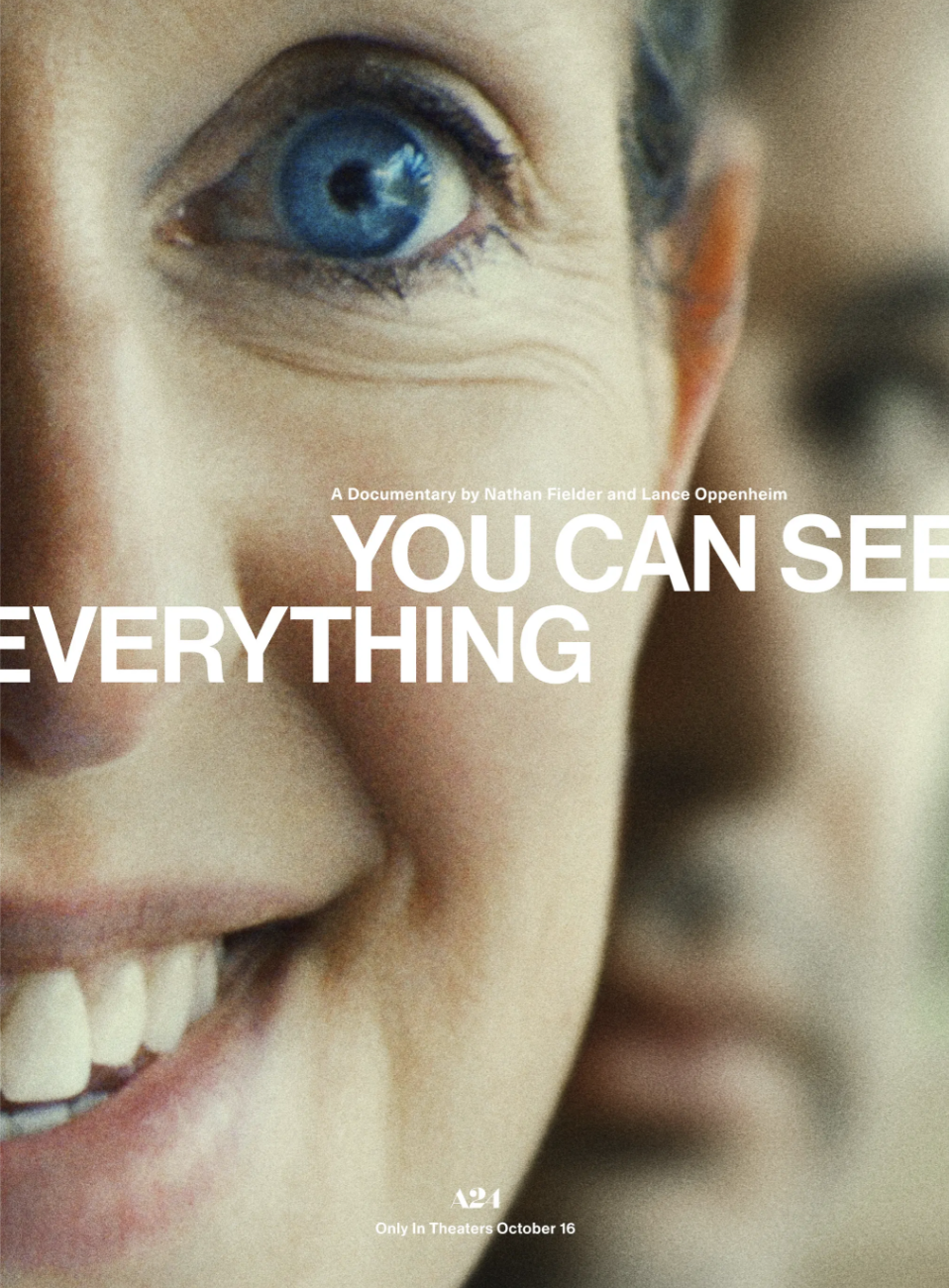
Andrew Moore ’28: Is ‘You Can See Everything’ a clear title? With its sans serif font and scenes behind the scenes behind the scenes, it seems to be as clear as Professor Abraham when instead of ‘hiding the ball’ of tort law, he holds it right out in front for all to see. Or is ‘You Are Capable Of Seeing Everything’ a more appropriate title?
Noah Montemarano ’28: Great question, Mr. Moore. I think what’s so brilliant about this documentary is that it’s just as much about “the ball” (in this case, Elizabeth Holmes) as much as our ability to perceive the ball. It asks whether objective documentary is ever possible, and whether documentary films—by their very nature—are always some degree of fiction. I guess the best title would be, “Are You Capable of Seeing Everything? Is Everything You See ‘Reality?’ What is ‘Reality?’” But I guess that title would be too long . . . .
Moore: Well, well, well, Mr. Montemarano, you and Fielder have certainly questioned reality better than anyone since Descartes! I think your point about objectivity is an astute one. On the one hand, by claiming “You Can See Everything,” it seems to be practicing radical transparency and objectivity, but on the other hand viewing it was clearly subjective. Some scenes inspired simultaneous raucous laughter, uncomfortable cringing, and stoic observation in our theater. How well do you think Fielder communicated his intended message? Or was there even an intended message?
Montemarano: Please! Mr. Montemarano is my father. I’ll respond to your question the way Professor Goluboff responds to questions she doesn’t want to answer: hand on chin What do you think?
Moore: So this is how the turn tables. Also, how do you know I was not addressing your father? Despite my words, you do not know what I was thinking. I think that unknowability of intention and fallibility of perspective is the point I received from the movie. Though an additional point of subjectivity is that you and I may have gotten different messages from it
Montemarano: Great point. I thought the most fascinating part of the movie was watching the audience’s reaction to it. I was frankly surprised to see where some people chose to laugh, where others chose to heckle the screen, or to sneer. It exposed just how differently people can process the same material. As you (very astutely) point out, that’s the second lens of subjectivity at play here. First, we’re processing Elizabeth Holmes through Fielder’s perspective; then we’re processing Fielder’s perspective through our own perspectives.
A question for you: how do you think this might change our understanding of the law? At times, I felt as if the audience acted as a jury pool for Holmes, and the film as the four corners of the courtroom.
Moore: Bold of you to assume I have an understanding of the law. I think the movie reinforced the imperfection inherent to the legal search for truth. Some people put law on a pedestal as the arbiter of truth and believe law can be reduced to math problems, so hopefully “You Can See Everything” knocks over the pedestal. It showed that even with the ability to see everything, it is still possible to know nothing. Indeed, seeing everything may obfuscate everything. Legally, this shows that no matter how much evidence or process is presented, a perfect truth will always elude the courts. This inevitability of legal mistakes, sometimes of grave consequence, may intimidate people. However, I think it can be viewed as encouragement to embrace the mentality that the law just has to be “good enough for government work.” Perfection will never be achieved, so all we can do is control what we can control and try our best to do what we subjectively believe is best, hoping that the sum of all our efforts will keep society on the right track. But I’ll digress from my philosophical meanderings; how do you think the movie might change our supposed understanding of the law? Can the movers and shakers of the law learn lessons from it or the comedy world more broadly?
Source: A24
Montemarano: Beautifully stated! Justice Jackson couldn’t have said it any better (Robert or Ketanji Brown—your choice).
I agree with all your points. I think the movie should teach lawyers to be humble about epistemology (for those who don’t know, pun intended, that’s a fancy word for how we know what we know). I also think it should teach us about comedy. Nathan Fielder is truly a master of the form. He uses it not only to break dramatic tension, but to highlight the most important themes of the film. I’m thinking of a particular bit involving a bowl of scrambled eggs, which at first feels like a distraction but helps us understand something fundamental about Holmes. I think lawyers could learn from his technique.
Moore: Well, if we agree on all the points, that is a good endorsement of neither the movie’s supposed subjectivity nor our potential as litigators (not that I aspire to be one). To that end, I posit instead that by using humor to highlight the themes, Fielder in fact creates more tension than he breaks. In the egg scene, if Fielder were not there, then Holmes and Billy likely would not have remembered the episode because, just between the two of them, there did not seem to be tension. By asking the persnickety question: “Is it Fielder who introduced the tension?” Throughout the movie, Holmes and Billy exist so completely in their own self-deluded world that there would have been little tension without Fielder humorously trying to reconcile their world with that of the audience. How else do you think audiences will disagree when it comes to interpreting the movie?
Montemarano: Hmmm, interesting point. I read that the directors (Fielder and Oppenheimer) decided to make the film once they realized that they disagreed on several of its central questions—chief among them, “Does Holmes actually subscribe to her own lies? Is she delusional, or is she manipulating the audience? Is it possible for both to be true?”
It’s a laurel/yanny crowd splitter, but one that tests our core assumptions about human nature. Personally, it reminded me of the debate over our president’s election denialism, on whether his actions are those of a cynical political actor, or of someone so narcissistic—so psychologically impaired—as to be incapable of admitting defeat. Like with Holmes, I’ve heard strident opinions on both sides. What do you think?
Moore: Without any firsthand knowledge, I will defer to the principle of “good enough for government work.” The court convicted her of defrauding investors even if other charges were left less resolved, so if the evidence of fraud was good enough for the government, then it is good enough for me. That said, the government has not judged the movie, so in its absence I would judge it a very strong four and a half out of five stars and very worthy of seeing. Any final thoughts, ratings, or summations?
Montemarano: Only one final disagreement: I’d give it the full 5/5 stars. This documentary has stayed with me all week, and I can’t stop thinking about it. Since audience reactions are such a fun part of the experience, I’d recommend seeing it with other people, either in theaters or at home with friends.

Authors: Noah Montemarano ’28 (pmn8ef@virginia.edu) and Andrew Moore ’28 (cwb5ex@virginia.edu)