
On April 29, 2026, the Supreme Court issued its decision in Louisiana v. Callais. The majority said it was reading Section 2 of the Voting Rights Act “as properly construed.” Justice Kagan, in dissent, wrote that the Court had made “a nullity of Section 2.” Though the full consequences of Callais remain to be seen, it is clear that there have been large shifts in election law, from redistricting to campaign finance to election mechanics.
On Wednesday, September 30, BLSA and ACS hosted “Voting Rights after Callais,” with guest speakers Professor Gilbert, director of UVA Law’s Karsh Center for Law and Democracy, and Professor Melody Barnes, the founding executive director of UVA’s Karsh Institute of Democracy. Professor Barnes served as Assistant to the President for President Obama and Director of the White House Domestic Policy Council, and spent more than a decade working in Congress, including as Chief Counsel to Senator Edward M. Kennedy on the Senate Judiciary Committee.
Three cases from last term
Professor Gilbert began by previewing the three election law cases the Court decided this past term.
The first, Callais, concerns Section 2 of the Voting Rights Act, which Professor Gilbert called one of the most monumental statutes in the nation’s history. Section 2 has long been understood to let minority voters sue over the way states draw district lines. The typical claim is minority vote dilution: a state has spread minority voters across several districts so they cannot form a majority in any one of them. In Callais, the Court rereads Section 2 and changes the test in a way Professor Gilbert said is widely regarded as contrary to the interests of minority groups. It now requires a plaintiff to show that the State intentionally drew its districts to afford minority voters less opportunity. Section 2 claims, he said, will now be much harder to win.

Credit: Benvin Lozada
The second, Watson v. Republican National Committee, concerns mail-in ballots. Many states count ballots that are postmarked by Election Day but arrive a few days later. The question was whether federal Election Day statutes forbid that grace period. In a 5–4 decision, the Court held that they do not. Federal law sets the date by which ballots must be cast, not the date by which they must be received.
The third, National Republican Senatorial Committee v. FEC, concerns campaign finance. Federal law had long capped how much a political party could spend in coordination with its own candidates. A party could spend freely on its own ads, but once it began coordinating with a candidate on what those ads should say, there were financial limits. On June 30, the Court held 6–3 that those limits violate the First Amendment, overruling its own precedent.
Asked whether the three decisions point in a single direction, Professor Barnes pointed to a broader trend of removing race from legal consideration, in voting and beyond.
A new test for Section 2
For forty years, Section 2 minority vote-dilution claims have run through the framework set forth in Thornburg v. Gingles. To succeed, plaintiffs had to show racially polarized voting and present an illustrative map, showing essentially, “here is how the state drew its lines, but it could have drawn them this way instead, with an additional majority-minority district.” It was not easy, Professor Gilbert said, but it was doable. Many Section 2 claims succeeded, and many states, anticipating that Section 2 claims could be raised, drew majority-minority districts from the outset.
Callais changes that test in three ways. First, plaintiffs may not draw the lines on their illustrative map based on racial demographic data. They must draw it on other grounds, where it still happens to produce more majority-minority districts. The Court said the Fifteenth Amendment mandates this.
Second, the plaintiff’s illustrative map must satisfy every one of the state’s legitimate districting objectives just as well as the state’s own map. Those objectives include legal requirements like equal population, traditional goals like compactness and keeping communities together, and political ones, like protecting a particular incumbent or maximizing a party’s seats. The dissent, written by Justice Kagan, argued the new test makes success effectively impossible.
Third, evidence of racial bloc voting must now control for partisanship. If white voters and black voters vote differently because they belong to different parties, the Court reasons, that is not racial polarization. How plaintiffs are supposed to disentangle race from party, Professor Gilbert said, remains to be worked out. Under the new regime, a state accused of sorting voters by race can more easily answer that it sorted them by politics.
What Callais means for representation
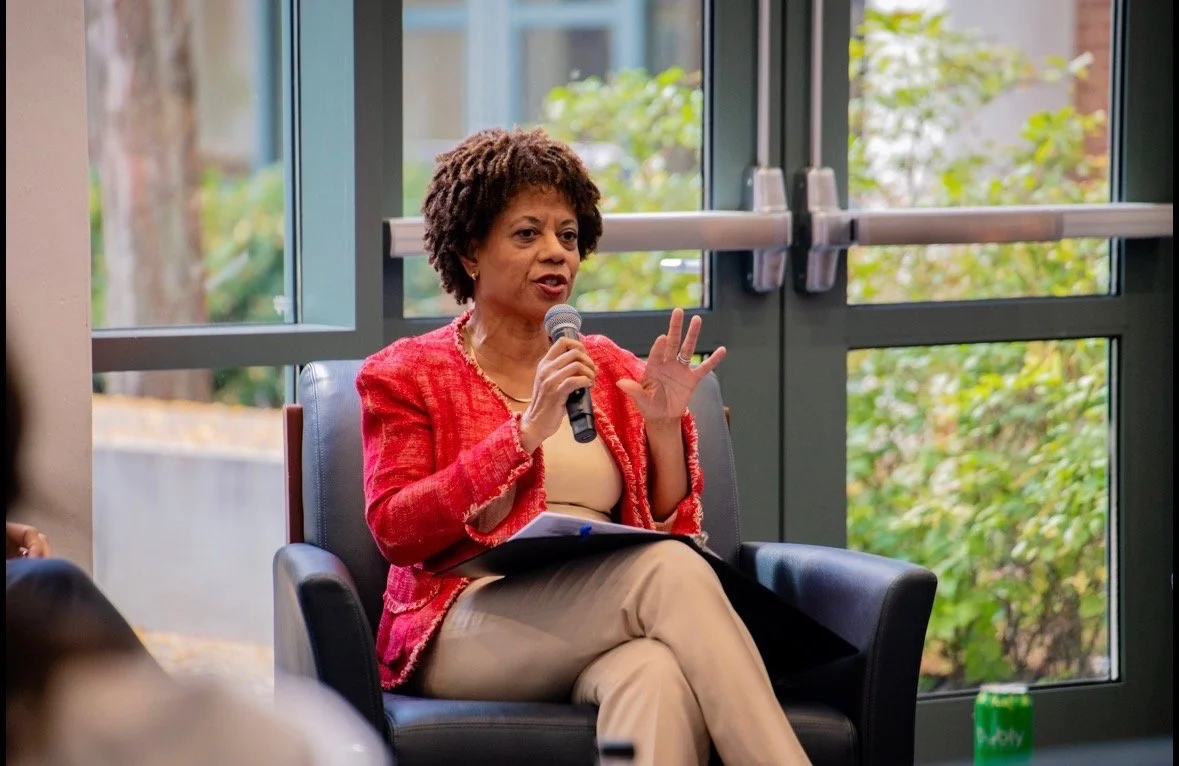
Professor Barnes framed the stakes in terms of power. Drawing on her work, she recalled recordings in which President Johnson told allies that his real objective was getting Black Americans the vote, because the vote meant power.
Credit: Benvin Lozada
When the Voting Rights Act removed barriers to voting, she said, increased representation followed. The number of Black members of Congress has grown dramatically since the mid-twentieth century, and she expects those numbers to start to drop, not only in Congress but in state and local offices, as Callais applies at all levels of government.
Trust in elections
Asked what worries him most looking ahead, Professor Gilbert pointed not to doctrine but to declining trust in elections. He noted that polls show widespread belief that the election process is rigged, but evidence of widespread fraud is non-existent. People have found isolated cases of voter fraud, but there is no evidence of a grand, coordinated conspiracy across multiple states. The concern, he said, seems radically out of proportion to the actual challenge. He offered that transparency might be a solution.
Professor Barnes said research supported by the Karsh Institute captured the same paradox. Surveying Virginia voters after the last gubernatorial race, researchers found that voters described their own experience at the polls as well organized and effective. Yet, many of those same voters also believed voter fraud was widespread.
The explanation, Professor Barnes said, lies in how people get their information. Most people say they do not trust social media, yet they also report that social media is where they get their news. They trust local journalism more, but local news needs strengthening (a focus of the Karsh Institute of Democracy).
Changing culture
Asked where advocates go from here, Professor Barnes said she does not expect federal legislation anytime soon. The action is in the states, where several have passed their own voting rights acts in the last few years. Still, she said, nothing replaces a robust federal voting rights act, because the places where protections are most needed are often the places least likely to adopt them.
Professor Barnes said she believes culture is essential. It changes hearts and minds, creates an ecosystem in which the work gets done, and can convince people that they have something at stake and that the system is worth fighting for, particularly when so many ask, given the money in politics, what one person can do. Legal and political activity, in her view, tends to follow once an idea takes hold in the culture.
Professor Barnes closed by reflecting on the semiquincentennial, and the questions the Karsh Institute plans to take up in the coming years: what self-government requires, and what it takes for self-government to thrive. She invited students to bring their research and ideas to that work.
Author: Alexis Pudvan, ‘28, nrt9un@virginia.edu