
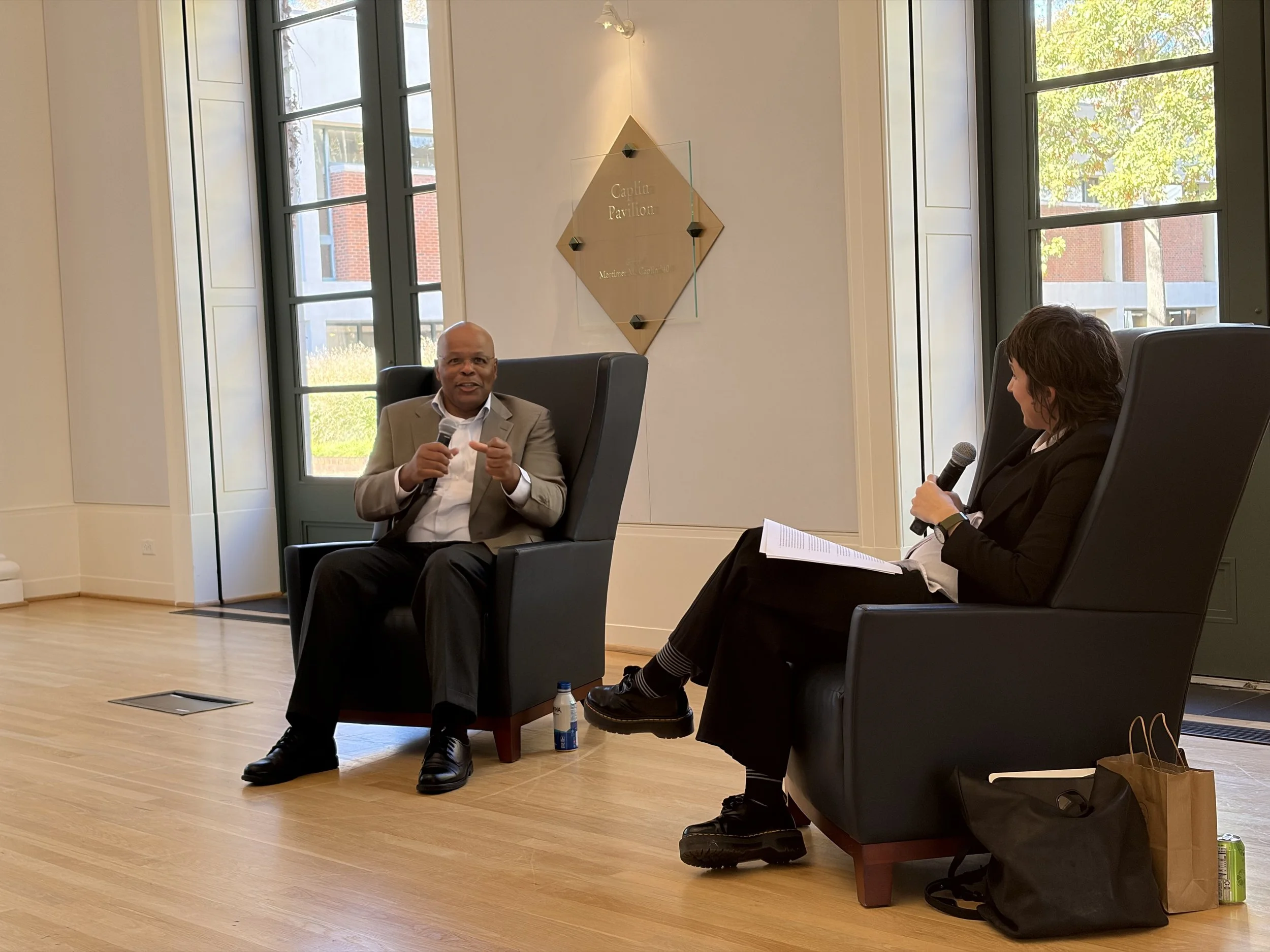
On November 10, Calvin Duncan, co-author of Jailhouse Lawyer, the story of his twenty-eight years in the Louisiana State Penitentiary, also known as “Angola,” where he served as an inmate advocate, came to speak to the UVA Law community in an event hosted by Law and Public Service and the Student Legal Forum. SLF Co-President Emmy Pilant ’27 introduced the event, and Professor Kelly Orians of GW Law–formerly head of the Decarceration and Community Reentry Clinic at UVA Law–moderated the discussion between herself and Duncan.
Duncan was convicted of murder in 1981 at age nineteen and sentenced to life in prison without parole. While incarcerated, he served as an inmate council substitute—a volunteer providing legal aid to prisoners who could not afford a lawyer, which, in Louisiana, they were not entitled to after appeal. Duncan successfully challenged many convictions of his fellow inmates and taught a weekly law class. His work inspired the creation of the New Orleans chapter of the Innocence Project in 2001. Duncan was released from prison in 2011 through the efforts of the Innocence Project chapter that he inspired and fully exonerated in 2021. He obtained his B.A. from Tulane University in 2019 and his J.D. from Lewis and Clark Law School in 2023.
When asked by Professor Orians what he learned from his time in law school, Duncan said that law school “confirmed what I already knew. . . . Law is the most powerful tool in this country.” Duncan also said that law school was hard. “I didn’t take medicine in prison. My second year in law school, I was on antidepressants. . . . But I enjoyed every minute of it.” Duncan talked of enjoying his professors and classmates and finding camaraderie with a bunch of very smart people still struggling to learn hard material. But Duncan said, “One of the things I knew I was missing, what nobody was telling us—how powerful the tool we were being given.” Duncan compared it to the One Ring from The Lord of the Rings. “I love Lord of the Rings.”
Source: Author
Duncan thanked Professor Orians, whom he knows through her work with the New Orleans Innocence Project, for being someone who used her power for good. Professor Orians returned the compliment: “[Duncan was] the very first person I called when I failed the bar after my first hit. And I'll never forget what he said. You told me, ‘People have been telling me I'm not a lawyer for thirty years. You have to get back up and get back to work.’” Professor Orians then asked Duncan, what makes someone a real lawyer besides a law license? Duncan answered: “What makes a good lawyer—to me—is [for them to] know why we have [the laws]. . . . [The founding fathers] wanted to make sure what happened to them never happened again. . . . Half of [the Bill of Rights] is to protect people like me. To protect people accused of crimes. Those people knew way back then who was going to need the most protection. . . . They weren’t thinking about me—they weren’t thinking about blacks—they were thinking about themselves. So they knew what they needed. That’s what makes—to me—a lawyer.”
Duncan went on to talk about his experiences at Angola—about what glints of mercy he had seen from the staff at the prison—and other stories from his book. One person he mentioned was Mrs. Dora Rabalais, a white woman and the wife of a resident worker at Angola, who “almost immediately took to the side of the incarcerated population,” according to Professor Orians. Rabalais eventually became the first director of the Legal Services Program at Angola. “[Mrs. Rabalais] saw the good. She saw they had people in prison that were innocent. And she understood that what they needed was protection and time to administer the law. To help people that could not help themselves. Because in Louisiana you’re not entitled to a lawyer after your appeal.” According to Duncan, Mrs. Rabalais had first-hand, on-the-ground experience that taught her that people at Angola prison were not receiving the type of resources they needed to get justice under the law. In order to be proper self-advocates, they needed legal classes, legal materials, and access to administrative systems of court—all of which were hard to get from inside the prison.
Duncan also told a story about an unprecedented shutdown of Angola prison. When Angola inmates began requesting records of their police reports, the Louisiana government enacted a law putting a one-year time limit to file in court. Many inmates were ignorant of this deadline to appeal and would not have made it. So the warden worked with the Legal Services Program to shut down all prison work at Angola for a day, and let the LSP “go all over the prison to make sure that everyone that wanted to meet the deadline met the deadline.” At the end of the day, they had collected 2,000 petitions, and the warden signed an affidavit saying that they had been delivered so the state “couldn’t play any games.”
The last in a long line of impressive and vivid stories about Calvin Duncan is the most recent: his run for elected office. Duncan ran for—and won—the office of Orleans Parish Criminal District Court clerk. But four days before his term was supposed to begin, Louisiana passed legislation abolishing the position. Duncan ran on a platform of creating access to court records that he and other prisoners had fought for in jail. While the Louisiana Supreme Court upheld the law 4–3, Duncan still has claims pending in federal court.
Duncan’s book, Jailhouse Lawyer, is out now. If it’s anything like his talk, this author suspects it will be a very engaging read.
Author: Bradley Berklich (jqr9gh)