
Martin Luther King, Jr. Day Celebration
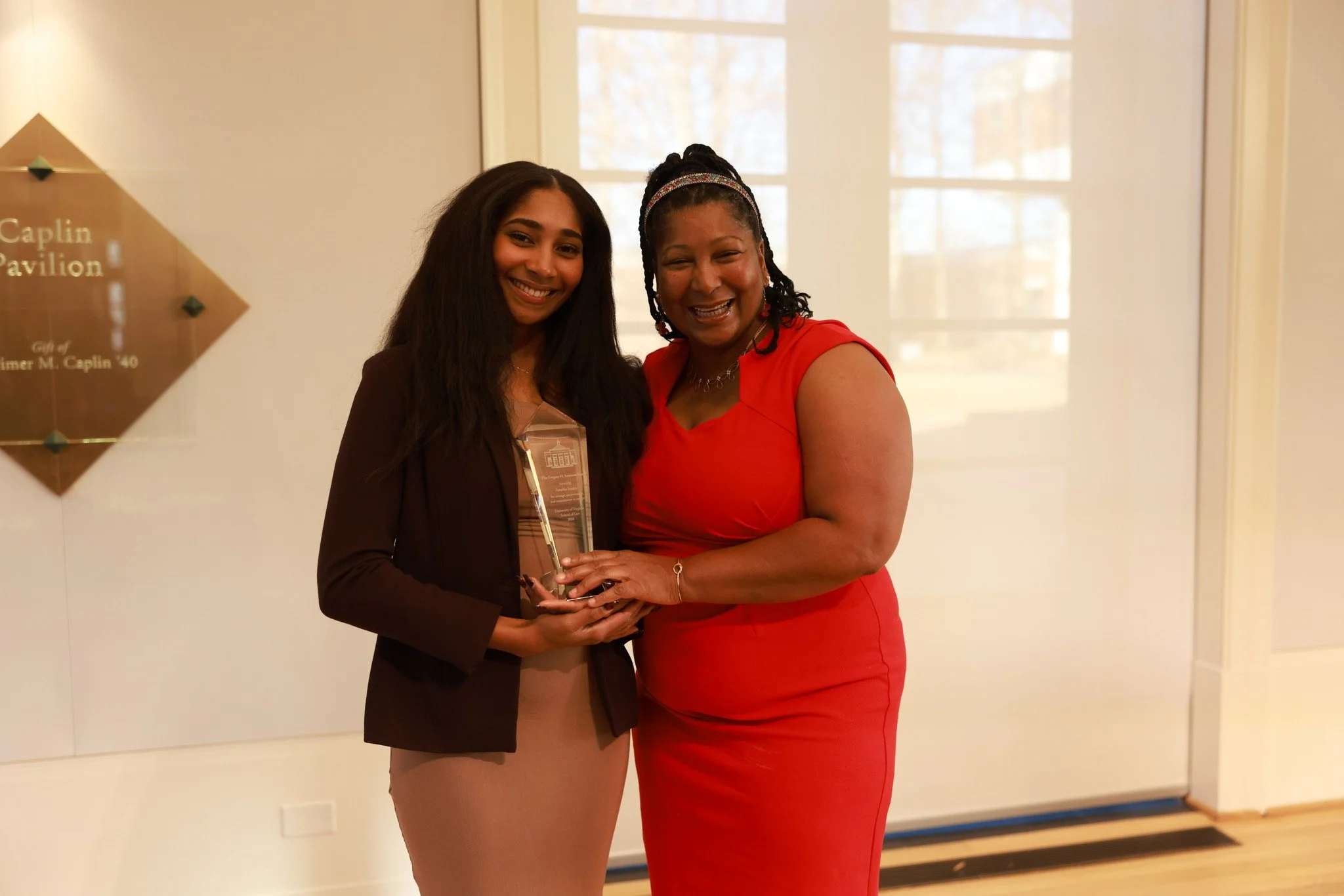
Pictured: Amelia Isaacs ’26 and her mother
On Wednesday, January 21, 2026, the University of Virginia School of Law held the annual Martin Luther King, Jr. Day community celebration. The event was cosponsored by the Center for the Study of Race and Law and UVA Law’s Black Law Student Association (BLSA). At this year’s celebration, former University Rector George Keith Martin ’75 served as the keynote speaker delivering a lecture titled “Patient, Persistent, Purposeful—the Leadership of Dr. Martin Luther King” and Amelia Issacs ’26 received the 2026 Gregory H. Swanson Award.
Professor Kimberly Robinson ’92, the University’s Karsh Bicentennial Professor of Law, White Burkett Miller Professor of Law, and founder and director of the Education Rights Institute, began the evening by welcoming guests to the event and sharing some words from Dr. King’s 1963 “Letter from a Birmingham Jail” that she believed are of particular importance to the legal community in current American society.
“[In “Letter from a Birmingham Jail,] he says many things about justice, and I thought that as a law school that it would be wise to remember this as we think about honoring King and also about the work that we all do here, training young lawyers, becoming future lawyers, and the role that we serve as lawyers in society,” Robinson said. “So he writes ‘I cannot sit idly by in Atlanta and not be concerned about what happens in Birmingham. Injustice anywhere is a threat to justice everywhere. We are caught in an inescapable network of mutuality tied in a single garment of destiny.’”
After delivering the welcome, Professor Robinson introduced Dean Leslie Kendrick ’06 to present the Gregory H. Swanson Award to its tenth recipient, Amelia Issacs. Dean Kendrick began by thanking Professor Robinson and the evening’s keynote speaker, former Rector Martin. Next, Dean Kendrick discussed the importance of Gregory Swanson to the UVA community and marked the 75th anniversary of Swanson’s residency at the law school as an LL.M student.
“Gregory Swanson was the first Black student at the Law School, the first Black student at the University of Virginia, and the first student to study on an integrated basis at any formerly white university in the former Confederacy,” Dean Kendrick said. “This past September marked the 75th anniversary of his admission to the Law School, and this school year is the 75th anniversary of his residence at the Law School.”
The Swanson Award was conceptualized in 2018 to recognize Gregory Swanson’s legacy in combating racial injustice. Swanson was first rejected from the Law School’s LL.M. program in 1950 on account of his race. In conjunction with counsel from Hill, Martin, and Robinson and the NAACP Legal Defense and Education Fund, Swanson sued for admission in federal court and won. The Law School uses the Swanson Award to honor a member of the law school community “following [Swanson’s] path through their courage, perseverance, and commitment to justice.”
This year’s recipient, Amelia Issacs, graduated summa cum laude from Florida State University with a bachelor’s in political science. Dean Kendrick recognized Issacs for her contributions and service to the Law School as a secretary and 1L senator for UVA Law’s Student Bar Association, a Community Fellow, editorial board member for the Virginia Law Review, member of UVA’s Raven Society, and historian and president of UVA Law’s BLSA chapter. Dean Kendrick also highlighted Issacs’ contribution to the school’s BLSA chapter through the creation of the “Endless Possibilities Partnership” with local Charlottesville public elementary schools and receipt of the Mid-Atlantic Chapter of the Year award.
Dean Kendrick read portions of the nomination letters for Issacs from professors and students remarking on Issacs’ outstanding character in and outside of the classroom.
“Professor Andrew Hayashi wrote, ‘Amelia was an enthusiastic and conscientious participant in our reparations class, who consistently modeled empathy as well as intellectual rigor, as we discuss topics that are emotionally charged. She was honest but also open minded, which I think is its own kind of courage,’” Dean Kendrick said. “A third year classmate [said,] ‘While many 3Ls disappear, Amelia has stayed present, supporting 1Ls in ways that go above and beyond. When a 1L asked her to teach them how to take notes, she was there. When another asked her to review their practice exam, she began reviewing her old notes. It made me realize that during her time in student leadership, Amelia did not help students simply because that was part of the role. She sought out these positions because she cannot help but help others, and she would do so with or without title, without recognition, for as long as she was able.’”
In her acceptance speech, Issacs thanked the Swanson Award Selection Committee, her nominators, the University, and all those in attendance for the MLK celebration. Issacs also remarked on a moment from her childhood and its lasting impact on her life.
“Everything I am today, and everything I keep trying to become, comes from one experience of being seen, accepted, and loved by my friends,” Issacs said. “Knowing how compassion and kindness had the power to change my life, it is my number one goal to lead with love when I serve, and the beautiful thing about it is that by putting love into the universe I’ve received so much of it back.”
Issacs also gave special recognition to her mother and her partner, Kyle Trotman ’26, for their steadfast support during her journey through law school.
“To my partner, Kyle Trotman. Last semester, Professor Sajadi told me one of the reasons that she’d been able to thrive through long hours and the pressures of the profession is a choice of a supportive partner. You have been that for me. For three years, you have been an unwavering constant, my biggest cheerleader, my favorite study partner, and my best friend,” Issacs said. “And most importantly, to my mom . . . . I love you more than I can put into words. Everything good in me comes from you. . . . I wish I could tell you that I was guided by some extraordinary courage or unique resilience, but the truth is a lot simpler.”
Following the presentation of the Swanson award, Professor Robinson introduced keynote speaker former University Rector George Keith Martin ’75. Martin graduated from the University and shortly after attended Howard Law School in Washington, D.C. Martin is a former managing partner at McGuireWoods and currently serves as counsel at the law firm with a primary practice in real estate, construction, and local government law. In 2011, Martin was appointed to the University Board of Visitors, and one year later in 2012 he was elected as the Vice Rector of the board. In 2013, Martin became the first Black American to serve as a rector for the University of Virginia and remains involved with the University as a professor of real estate law at UVA Law.
During his address, Martin argued Martin Luther King Jr. is one of the truest leaders to come from American society, despite his lack of formal title.
“[Martin Luther King Jr.] was one of the most complete leaders America has ever produced,” Martin said. “He didn’t hold elected office. He didn’t command an army. He didn’t control wealth, yet he reshaped the moral direction of our nation, and his authority came not from position, but from vision, discipline, collaboration.”
Martin also argued Dr. King’s strength as a leader was rooted in his powerful vision for a better America, and purposeful patient strategy.
“Dr. King was a visionary. At a time when segregation was embodied in law and custom and culture, he articulated a vision of an America that did not yet exist, but should, ” Martin said. “He not only condemned injustice, he imagined a beloved community grounded in dignity, equality, and shared responsibility.”
