
What the Duolingo Owl Doesn’t Teach You
As an American tourist on spring break, there is nothing more embarrassing to me than seeing other Americans being embarrassing abroad. I have a particular disdain for those who do not attempt to use the local language, and instead just go around brashly in English without ever trying to speak it. Believe me, I’ve seen an American tourist in Italy loudly repeat, “WATER. WA-TER” at a waiter as if volume would suddenly make English understandable.
I am a firm believer that everyone should know a few key phrases in the language of the country where they’re traveling. Locals are generally not mad that you’re “butchering their language.”[1] They’re annoyed that tourists think the world revolves around them. In my experience, people are actually excited, happy, and incredibly helpful when you try to speak their native language.
From free limoncello to snacks, discounts, and—dare I say—internal satisfaction, there is so much I have gained just by trying to speak the language. For me, life is less stressful when I can order food, go shopping, and solve metro ticket issues on my own. As a lifelong language learner and enthusiast, I love spending months preparing in advance—but language learning for travel really doesn’t have to be that intense. A little strategic preparation goes a long way.
Source: Author
Before you go: Low-effort Preparation
So, where do you start if you don’t want to be that tourist? When beginning a new language, I quite literally take baby steps. After all, babies don’t start by talking—they start by listening and absorbing the chaos around them. Luckily, it’s easy these days to find YouTube channels, podcasts, or music in your target language. Even better if you can find it in the local dialect or accent where you’ll be traveling. It might seem like procrastination—or worse, completely useless—since you probably won’t understand a single word yet. But you’re absorbing the rhythm, flow, and pronunciation. Quite frankly, part of the method to my madness is also about getting comfortable with not understanding everything.
Start with a small notebook or Notes app with common phrases and add to it as you go. You don’t have to memorize everything. It’s perfectly okay to look up a phrase in the moment, promptly forget it, and look it up again the next day.
Walk yourself through a day on vacation. You might order food, take a taxi, go shopping, or visit a museum. That means knowing phrases like:
Table for two.
The check, please.
How much does this cost?
Do you accept cash or card?
Can you please take a photo of us?
Think about your personal needs too. For example, I need to know “extra small” when shopping, and I would be remiss not to know “I’m lactose intolerant.” Maybe you’re a gelato aficionado and need to know how to order a cup or cone.
Your list doesn’t have to be exhaustive. You’ll quickly discover which phrases you reach for most often, and your list will adapt naturally.

Source: Author
In the Moment: Survival Skills
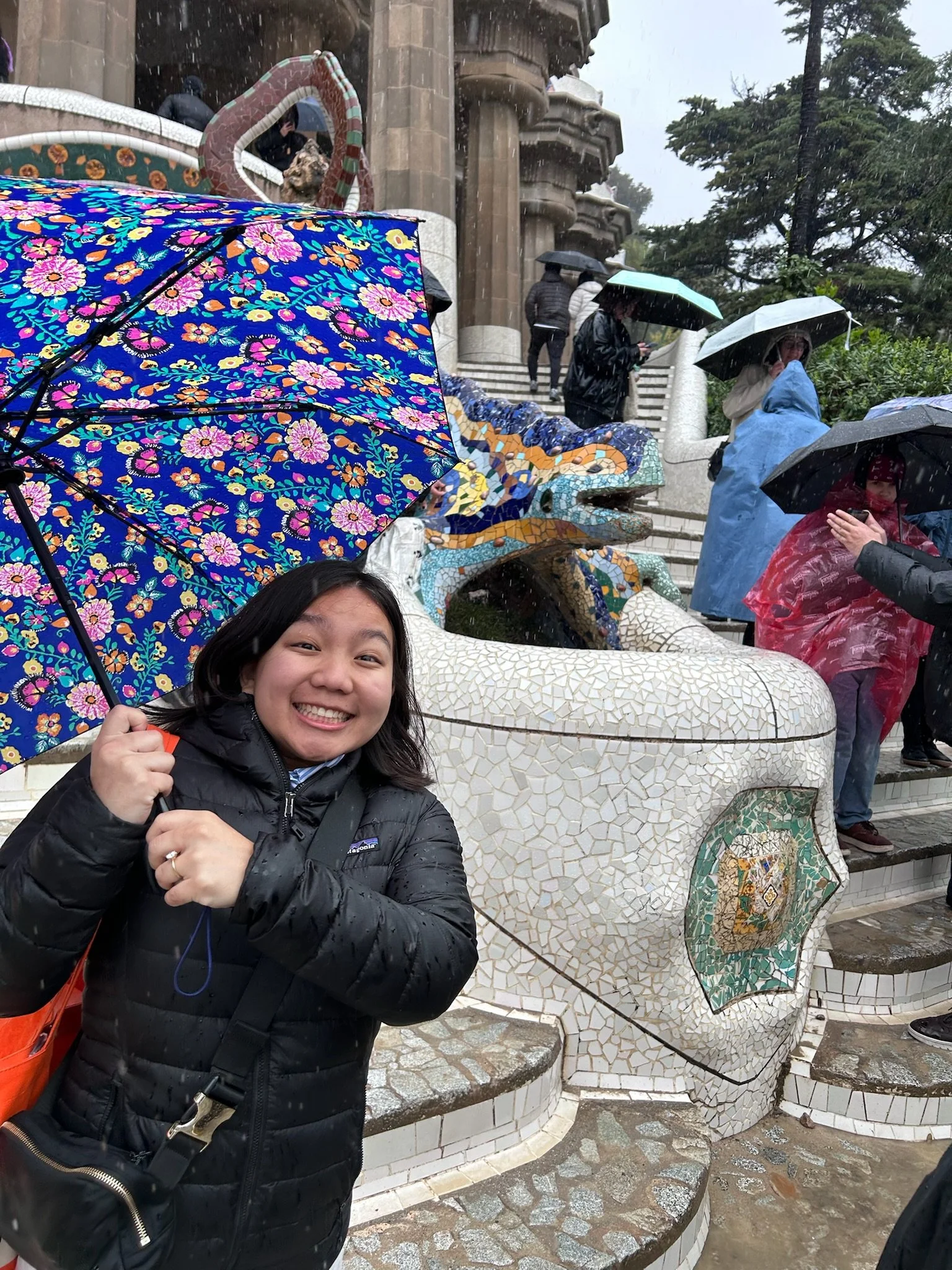
Of course, preparation only gets you so far. Do not panic if you do not understand every single word. We are tourists, not diplomats. Just get the gist, unless it is a more serious or formal situation. Just this Friday, I was fighting for my life when the taxi driver went full Catalan on me after I said the Catalan “si us plau” and “mercès” instead of the standard Spanish “please” and “thank you.” Two or three full sentences flew by me, but I caught something that sounded like “arrive,” and I heard “fifteen minutes.” That’s all I needed to know, and we indeed arrived at Park Güell fifteen minutes later. And I never said si us plau again.
Since it is impossible to know every word, it is also important to be comfortable describing things instead, or letting go of the wonderfully complex thing you cannot yet express. The other day, it was pouring in Barcelona, and I did not remember the word “impermeable” to find a raincoat. Instead, I asked for “una chaqueta para la lluvia.” A jacket for the rain. Close enough. You can get creative with this, too. I once didn’t know the word for lizard in French (yes, it was important to the story), so I went “euh, it’s like a snake but with four legs?” and I was immediately understood. You might try an educated guess at a word you’re not 100% sure of.[2] But be careful of false cognates. That is, words that sound like English ones but mean something completely different, and sometimes wildly inappropriate.
Which leads to a controversial opinion from someone who has actually taken many linguistics and translation classes: grammar is not the most important thing. Of course, you should try your best, but remember: function over form. A family friend of mine boldly speaks French often without conjugating verbs, matching adjectives, or putting words in the correct order. Yet she communicates far better—and gets far better results—than some of my classmates who know all the intricate grammar rules but freeze when speaking. What is the point of all that effort if you can only read and write but cannot talk to people in real time?
Just go for it! Reflect later on how you might improve. Do not let perfect become the enemy of good. As a tourist, it is often perfectly fine to be results-driven in your communication goals.[3] Which brings me to the one thing that does matter more than perfect grammar: pronunciation.

Source: Author
Make Yourself Understood
Try your best to get the pronunciation as best as you can from Day One. It is entirely possible to only know five words and pronounce them all correctly. You don’t need to wait until a higher level to start pronouncing things well. Go slowly. Repeat them out loud. Don’t engrain bad habits, especially with words that look similar to English. Really listen to what the word sounds like versus what you’re actually saying. Which syllable is stressed? Is the vowel short or long? Any silent letters?
I am not suggesting that a “perfect” accent is the ultimate goal or even a necessary one. The point is simply to make yourself easier to understand. You may have spoken with someone with a strong accent in English. They may speak fluently with expansive vocabularies, yet their pronunciation can sometimes make them harder to follow. There is nothing more frustrating than knowing you’re saying the correct words, but not being understood.
Social Engineering
For those of you in that liminal level where you understand more than you can speak back, learn a few filler phrases. Instead of nodding awkwardly and saying “yeah” a hundred times, you can respond with things like:
That’s so interesting.
I see.
That makes sense.
I didn’t know that.
Wow, really?
I agree.
That’s good to know.
Now for a classic conundrum: what if you are bent on practicing your target language, but native speakers keep switching to English? First, understand that they’re probably trying to make the interaction easier for both of you. And honestly, you can empathize with them wanting to practice their target language too. But sometimes it becomes a petty little battle.
It’s all about language-mogging, my friends. Speak their language better than they speak English. Or simply refuse to switch to English. I suppose you could politely say that you are trying to practice, but where’s the fun in that?

Source: Author
Mindset & Expectations
Lastly, ask yourself: what is your goal in the language? Your path—and your satisfaction—will depend on this answer. Are you just curious to try it out? Do you want to travel more easily? Make friends? Get certified as a near native speaker by the French government? Tailor your goals and expectations accordingly.
And remember, tough interactions happen. Don’t give up! Do not let five minutes of a bad exchange ruin the other 1,435 minutes of your day. Learn from your mistakes. Try not to take it personally. And try again. Your confidence will grow with every positive interaction and every small success. Putting yourself out there can be hard and scary. But you can do hard things, and you can do them scared. Now go get out there, my baby polyglots. And do NOT embarrass me.
Sophie Zane ’27, yjt8nw@virginia.edu
[1] Think about it. If someone speaks broken English to you, do you ever judge them or take offense? No, you appreciate their effort and do your best to work with them.
[2] In the moment I was considering guessing lizard was “lézard,” but that felt too good to be true . . . .
[3] See, e.g., my partner silently pantomiming “nail clippers” to the store clerk and successfully returning with a pair. Did the clerk give him a dirty look and charge him two more euros than the price tag? Yes. Does this prove my point of why trying to speak is important? Also yes.