The Bowling Alley Cares Not If You Are Bowling Alone
Robert Putnam famously warned that Americans are increasingly “bowling alone,” a symptom of the slow dissolution of the civic fabric that once bound communities together. His evidence was extensive: declining membership in clubs, fewer neighborhood gatherings, the steady disappearance of Rotary meetings and Elks Lodges into the long twilight of institutional America.
But Putnam did not account for the Virginia Law Weekly.1
Last Thursday night, a small but deeply concerning pocket of civic engagement emerged at the bowling alley off Route 29, where several members of the Law Weekly editorial board convened with staff for what can only be described as an ill-advised social experiment. Contrary to Putnam’s thesis, these individuals were not bowling alone. They were bowling together, which proved far worse for everyone involved.
Bowlero is a place where time moves differently.
You may have driven past it before, or perhaps you have not. Perhaps it only appears when you are already slightly tired, when the sky is the strange gray-purple color that suggests evening but refuses to commit to it. The sign reads BOWLERO, though the letters flicker occasionally, as if uncertain about the truth of their own existence.
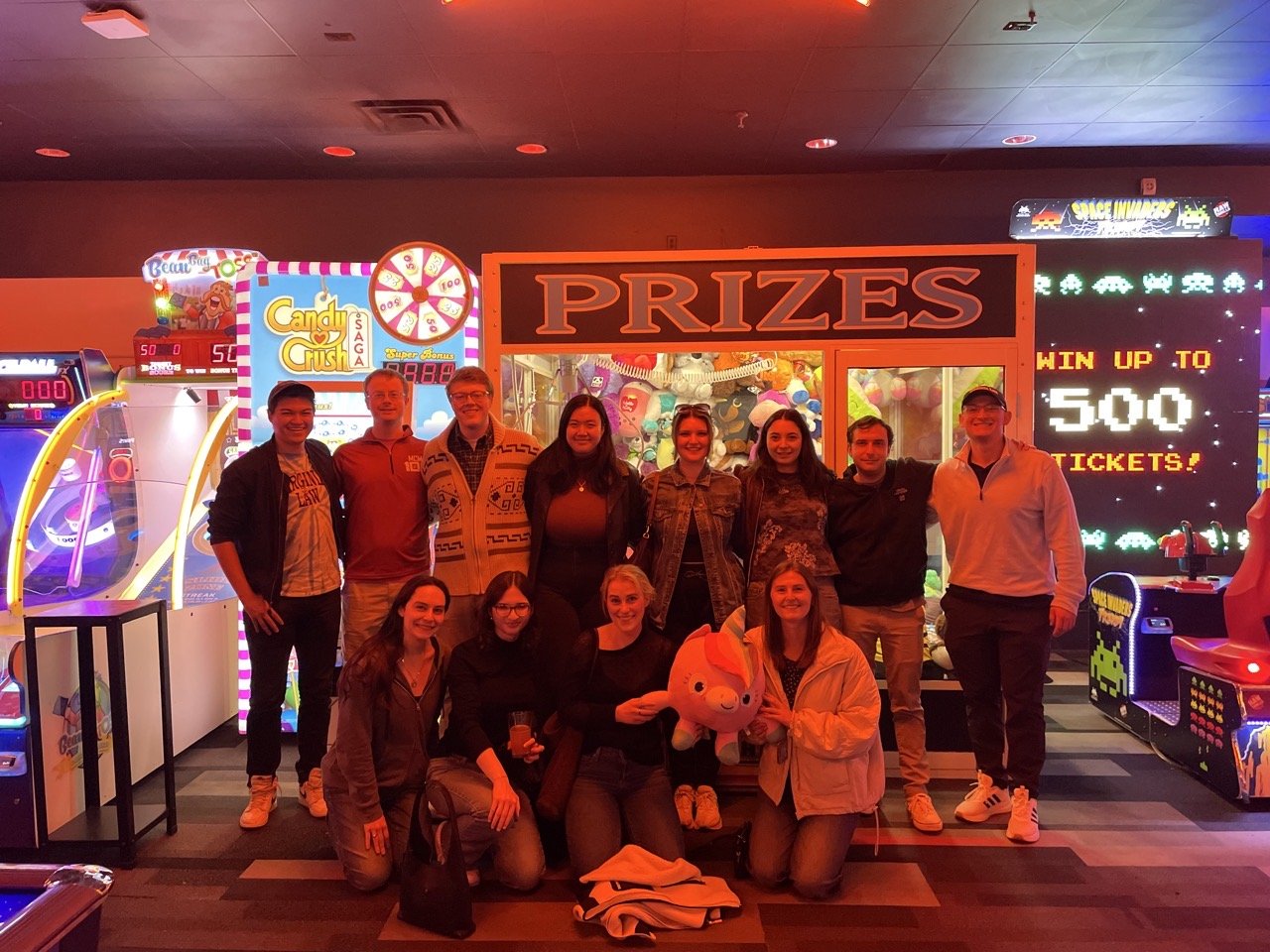
Inside, the lights are always the same color, though no one knows exactly what color that is: a low, nonspecific neon glow that suggests both celebration and medical examination. The carpet is patterned in shapes that appear random at first glance—swirls, stars, neon streaks—but if you stare long enough, you may begin to suspect it is a map. Of what, no one knows. Possibly the lanes themselves. Possibly something much older. Something in the arcade.
Source: Author
The bowling balls wait in their racks like silent planets, each one bearing the mysterious triple-hole geometry that has baffled philosophers for centuries. If you place your fingers inside them, you may feel a strange sense of destiny. I mean dysentery. You may also feel a sort of warm, viscous substance ooze around your fingers. You will be told that it is a sad consequence of amateur bowlers on Half-Off Wing Night (the professional bowlers always eat wings with their left hands and bowl with their right). The staff insists it is buffalo sauce. They do not elaborate, nor do they answer any of your questions. Your concern lingers longer than the sauce itself, which disappears after the third regurgitation of the bowling balls back to your port.
The lanes stretch forward in perfect symmetry, long wooden corridors leading to the distant white sentinels of the pins. Ten of them. Always ten. No one has ever successfully explained why ten is the correct number, but no one has dared suggest eleven.
Sometimes the pins fall.
Sometimes they do not.
Sometimes they fall in patterns that appear to spell things.
Putnam mourned the disappearance of bowling leagues, once pillars of American civic life.
Watching the Law Weekly attempt to bowl collectively suggests that those leagues may have dissolved for very good reasons.
The machine above the lane will record your score with quiet, unquestioning authority. It does not care if you understand the scoring system. It does not care if anyone does. The numbers appear. They accumulate. Eventually, they stop. Music videos play above the lanes, flickering seamlessly between genres and eras. K-POP melds with Cher and Black Sabbath, and sometimes, when there is a lull between music videos, you can just barely hear the sound of Gregorian chants, ancient and monophonic.
Your rented shoes are handed to you by a person whose expression suggests they have seen things. You try to communicate that you, too, have seen things, but then the shoes are too red and too blue, in a pattern that once may have meant something. No one remembers what. The shoes are slightly too large, or slightly too small, or both at the same time. Why do we wear bowling shoes? Does anyone truly believe that it’s to “protect the bowling lanes” or “provide adequate traction?” They’re so slippery. I can’t get my feet under me. My bowling game suffers, all for these infernal shoes.
You will wear them anyway.
Somewhere behind the counter, the fryer hums endlessly, producing mozzarella sticks that are both too hot and somehow already cold. You purchase a “Power Tower” of beer because the soda machine dispenses beverages in colors that do not appear in nature. Emma gets a milkshake. The flavor is Twix. Children celebrate birthdays with a joy that feels rehearsed, like a ritual performed to appease the bowling gods. Everywhere—and I mean fuckin everywhere—paintings and stylings of a giant elk loom over the bowlers. Is this their god? Can cloven hooves even grasp bowling balls?
Source: Author
Every few minutes, the mechanical arms descend to reset the pins.
No one has ever seen the machinery fully. It exists above the lanes, behind a curtain of darkness and noise. It knows when you have finished your throw. It knows when the pins have fallen. It knows other things, too. It has always known. Alexis and Emma discuss what it would be like to slide down the alley themselves, to see what lies beyond. Nervously, we tell them to stop. They will be hurt. They will be hurt.
Occasionally, someone achieves a strike.
When this happens, the screen flashes brightly, and a celebratory animation plays. It is an underwater society. Sometimes, various sea creatures appear, ostensibly playing in a lighthearted underwater band. A hermit crab plays the triangle. An octopus plays the steel drums. Other creatures look at first to be real animals from our oceans, but upon closer examination, something’s not quite right. You look closer, determined to identify these strange sea creatures. Instead, you discover something jarring. The octopus is manacled to his drum set. He plays well. He never stops playing. The hermit crab’s eyes are bloodshot and afraid.2 What are they to an elk? What are any of us to a god?
If you remain long enough, you may begin to lose track of how many frames have passed.
Ten frames, the rules say.
But the scoreboard sometimes shows eleven.
Or twelve.
No one comments on this. You must not comment on this.
The elk is everywhere. The elk is patient. The elk is watching the scoreboard.
Eventually, you will grow weary of the lanes and find yourself in the arcade. If you happen to remember walking there, it’s only because your fight/flight prey drive kicked in when you felt the boring stare of an older woman wearing a neon orange Lycra jersey emblazoned on its back with the words “BOWLING ANIMALS.” Her eyes track your every step.
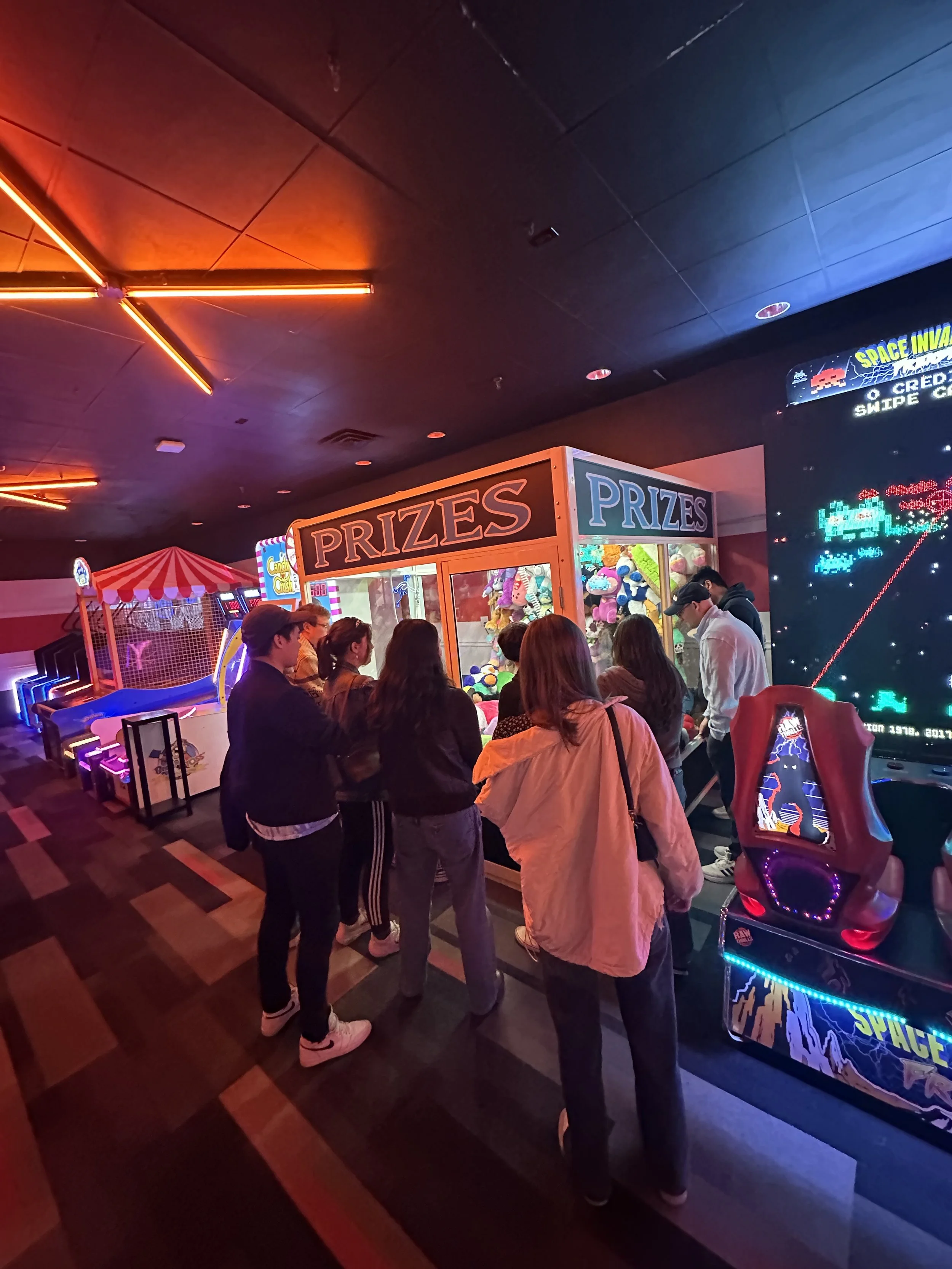
Finally, you make it to the refuge of the arcade. The air is softer and sweeter here, and you feel relief. You might not notice that there’s another faint smell, something rotten that the sweetness masks. The machines glow with a soft, insistent brightness, as if they are trying to communicate urgent missives with passing satellites.
They all want something from you.
Some want quarters. Some want tokens. Some want a prepaid card that must be swiped against a sensor that does not always acknowledge your existence. Some keep saying your card is declined, and then Brad has to buy your arcade tickets for you (thanks, Brad).
In exchange, they offer games. The games are simple. Roll the ball. Shoot the hoop. Destroy the alien fleet. Pilot a large metal claw to kidnap a large plush toy. They have been offering these same challenges since approximately 1987, and they will continue offering them long after the bowling alley has been reclaimed by vines and raccoons.
You tell your fellow Law Weekly heads that you are the Queen of the Claw [game]. You struggle vainly to snag a large, grotesquely humanoid stuffed pickle. He slips from your grasp, then from Brad’s, falling back into the pile with the calm confidence of something that has done this before. And smug in the way only imprisoned vegetables can be. You feel rage building up behind your eyes, which you can feel pulsing in your head.
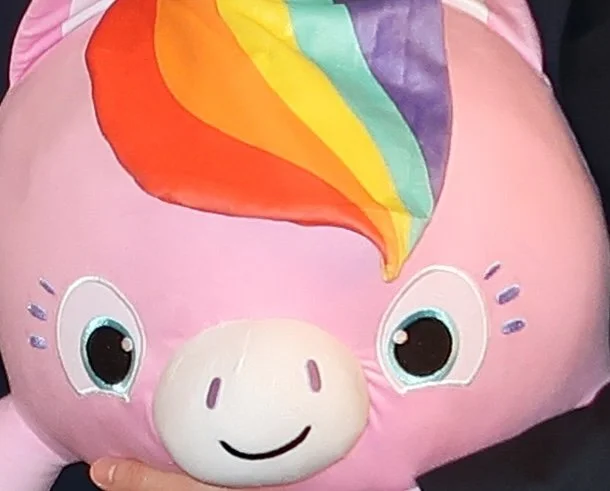
You switch strategy, hoping to allay the darkness rising within, aiming for a pink orb. Success. It is a . . . unicorn? You proudly carry it back to your colleagues, pushing down the sense of unease you feel when you look into its eyes. “What should we name it?” you ask your friends. They can’t answer. They laugh delightedly even as tears fill their eyes.
Source: Author
Some of the machines are not fully games.
There is a racing simulator where you drive through cities that resemble Earth but are not Earth. The roads loop impossibly. The sky is always sunset. The steering wheel is sticky with the accumulated fingerprints of strangers. Muscle memory kicks in as you sit in the seat. Instinctively, you check for a seatbelt. Your lips whisper a prayer in a language you do not know.
There is a basketball game that gives you exactly thirty seconds to prove that you are worthy of joy. Most of us fail. The one that didn’t dropped out of law school the next day.
And sometimes, the machines play themselves. Not fully. Just enough to remind you that they could. Late at night, when the bowling lanes grow quiet and the birthday parties have retreated to their minivans, the arcade continues blinking and humming. The screens flash scores belonging to players who are no longer there.
In Bowling Alone, Putnam warned that consumer entertainment was replacing civic engagement. The arcade would seem to confirm this theory, except that no one here appears to be having fun. Putnam also worried that Americans were losing the small rituals of communal life—the habits of gathering in ordinary places to do ordinary things together.
The Bowlero on Route 29 suggests that those rituals may still exist.
They are simply much, much more ancient than he imagined.
Eventually, you will return your shoes and step back outside into the night air of Route 29. You’ll bum a Marlboro Southern Cut. Someone says this builds social capital, yet another Putnam reference that prompts canned laughter from the rest. You take a deep breath, then close your eyes for a moment. When you open them, you will be alone. The parking lot will be quiet. The highway will hum softly in the distance.
For a moment, you may wonder whether you imagined the entire thing.
You did not.
The Bowlero is still there.
The lanes are waiting.
And the pins—patient, silent, eternal—are already standing back up.
As you get to your car, you notice cloven hoofprints burned lightly into the asphalt by the driver’s side door. You wouldn’t have noticed, except one is still sizzling. You follow the tracks with your eyes. They lead away from your car, but stop abruptly, as if the walker had just winked out of existence.
Americans may be bowling alone.
But something here is always bowling.