Law School Easter Eggs
The University of Virginia School of Law does not wear its quirkiness on its sleeve. The uptight nature of law, and the removed northern grounds and modern building of the Law School isolate it from the idiosyncrasies of the youthful yet ancient main grounds of the University. Still, some pockets of whimsy sneak into the Law School. A few of them are detailed below.
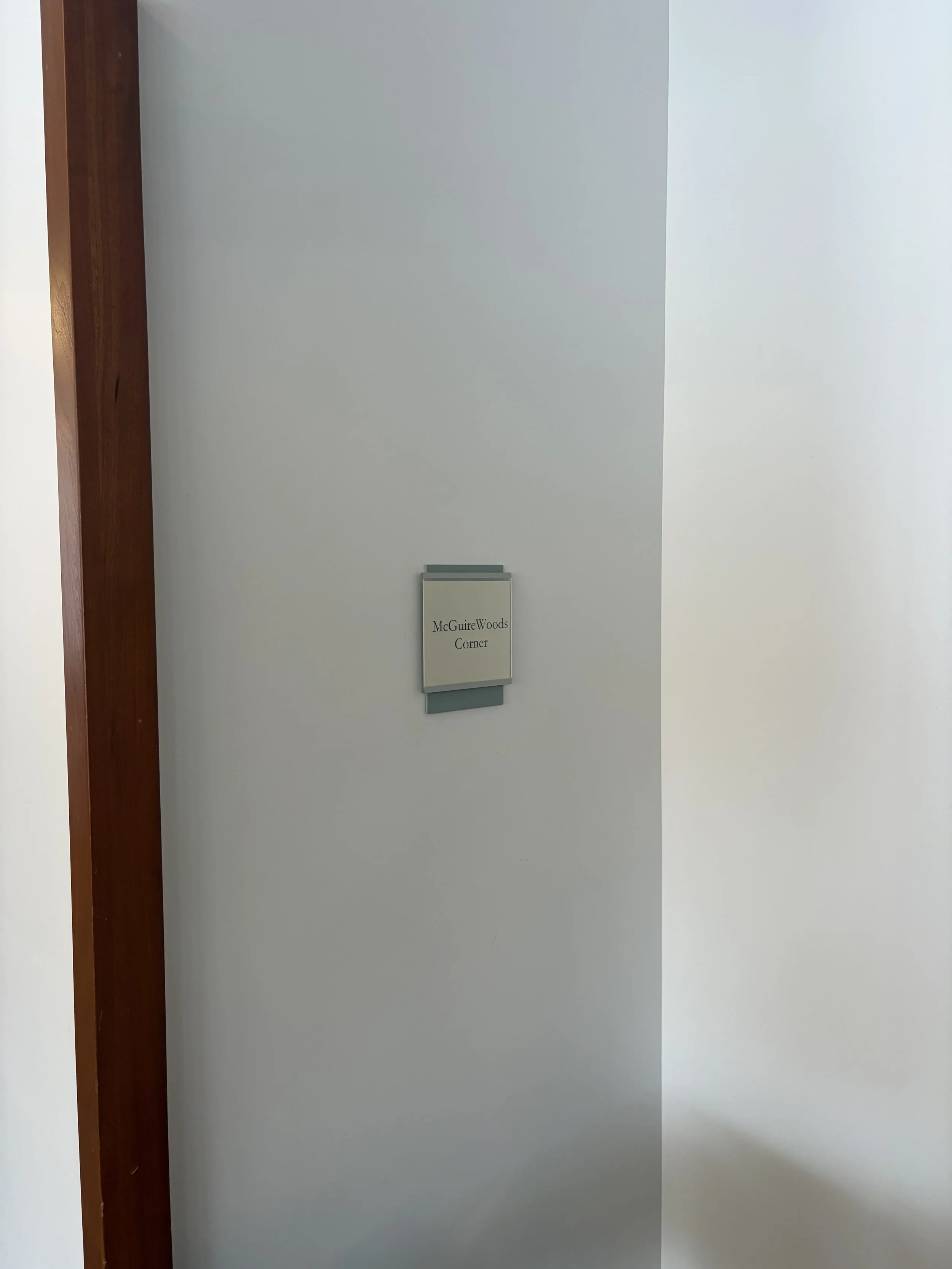
McGuireWoods Corner
We are all very familiar with firm-branded classrooms and hallways around the Law School (see, e.g., Hunton Andrews Kurth Hall (“HAK”), and the Bradley Arant Boult Cummings & Hogan Lovells [Cadwallader] Classrooms). But there are some smaller nods to Big Law firms scattered around. One of these is the humble McGuireWoods Corner, right next to the Law Bookstore. The Corner is perhaps two feet by two feet and often houses one-fourth of the Bookstore’s table of discount items.
It’s not clear why this particular corner was selected. Perhaps the sale table needed sponsorship. Perhaps there’s some Law School alumnus who was particularly fond of this corner (maybe a nod to the infamous Corner on Main Grounds). Or maybe McGuireWoods had a few extra thousand dollars lying around and thought it would be funny. It is funny, at least to this law student. One must wonder exactly how much a corner costs. Presumably far less than a classroom (which McGuireWoods also has) or a hallway.
Source: Author
Portrait-Shy Professor
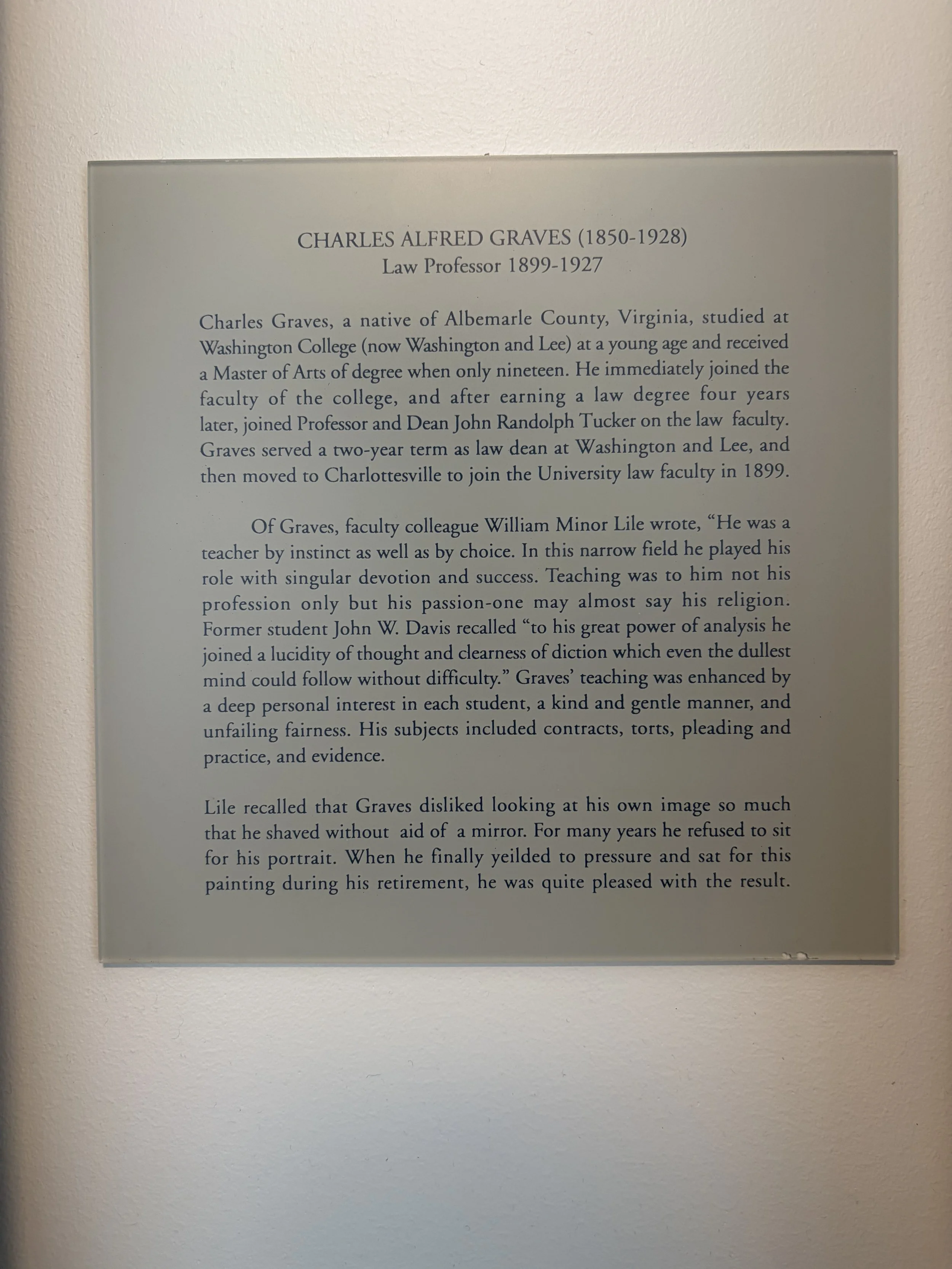
On the second floor of Slaughter Hall, in the back corner near the study tables, is a portrait of Charles Alfred Graves, a UVA Law professor from 1899-1927. According to his plaque, Graves had a “great power of analysis [that] joined lucidity of thought and clearness of diction which even the dullest mind could follow without difficulty.” Graves taught Contracts, Torts, and Evidence, amongst other subjects.
Graves was also very unhappy with how he looked. The plaque goes on to say, “he disliked looking at his own image so much that he shaved without aid of a mirror. For many years he refused to sit for his portrait. When he finally yielded to pressure and sat for this painting during his retirement, he was quite pleased with the result.”
The portrait does look pretty good. Graves didn’t have much to worry about. If you have some extra time, nip up to the second floor to see it for yourself.
Source: Author
Bork(‘s) Suitcase
Tucked into the annex just outside of SLXXX, the office of the Federalist Society and other organizations, is a black hardshell suitcase with a luggage tag, presumably indicating that its owner was a one “D. Bork.” One might presume that this belonged to a relative of Robert Bork, Supreme Court Justice hopeful, whose poor Senate testimony ultimately ended up costing him the position (helpful hint if you’re ever being judged by the Senate for this role: don’t forecast your votes on controversial cases, and don’t refer to the privilege of serving on the Court as “an intellectual feast”). This event also gave rise to the word “Bork,” which Merriam-Webster's Online defines as “to attack or defeat (a nominee or candidate for public office) unfairly through an organized campaign of harsh public criticism or vilification.”
It would be presumptuous to conclude that this is indeed Bork’s suitcase. This author can turn up no evidence that R. Bork is related to a D. Bork (who may indeed be a securities lawyer in Ohio, but one who has never visited the University of Virginia), but it is a big coincidence, and it might explain how the many copies of The Antitrust Paradox came to arrive in the office. If you want to get your hands on one, you need only win the Federalist Society’s annual student-faculty pickleball tournament, where a copy of the book is the traditional prize.
Beane’s Brick
Even before he was played by Brad Pitt in 2011’s Moneyball, an adaptation of Michael Lewis’ book of the same name, Billy Beane was the legendary general manager of the Oakland Athletics. Beane was a front-runner in figuring out how to do more with less—that is, how to play better baseball without paying for a bunch of really expensive all-star players (“You guys are still trying to replace Giambi. We can’t do it. . . . What we might be able to do is recreate him. Recreate him in the aggregate.”) Beane was also part of the push to recruit players earlier, in high school, and to emphasize defensive skills (perhaps the new future of Big Law recruiting too?).
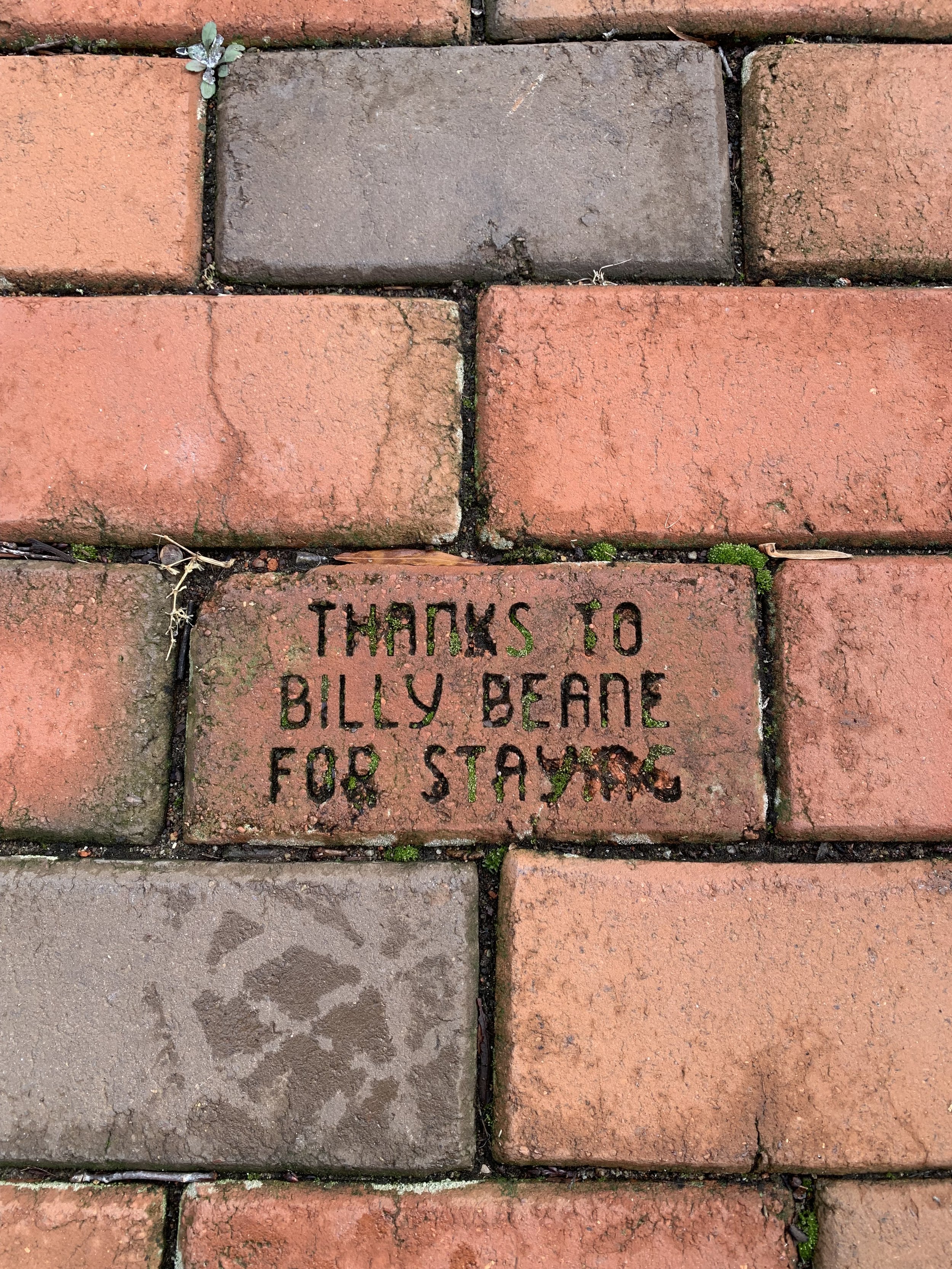
Beane was courted by the Boston Red Sox to become their general manager in 2002, but he refused and stayed as the A’s GM until 2015, when he was promoted to “executive vice president of baseball operations.” There is an easy-to-miss brick in the walkways of Spies’ Garden, near the west doors, that gives Beane some appreciation for his loyalty to the A’s. It reads “Thanks to Billy Beane for Staying.”
Source: Author
Author: Bradley Berklich ’27, jqr9gh