
UVA Law rolls out administrative policy changes
UVA Law students returned to grounds last week and were greeted by a number of administrative policy changes to building access, classroom attendance, and video recording.
The rollout of these administrative policy changes has triggered confusion among the student body, as well as apprehension about additional changes to Law School policies.
The Law Weekly sought explanation from Law School administration regarding the exact nature and rationale behind the implementation of these policy changes.
Qwickly Attendance
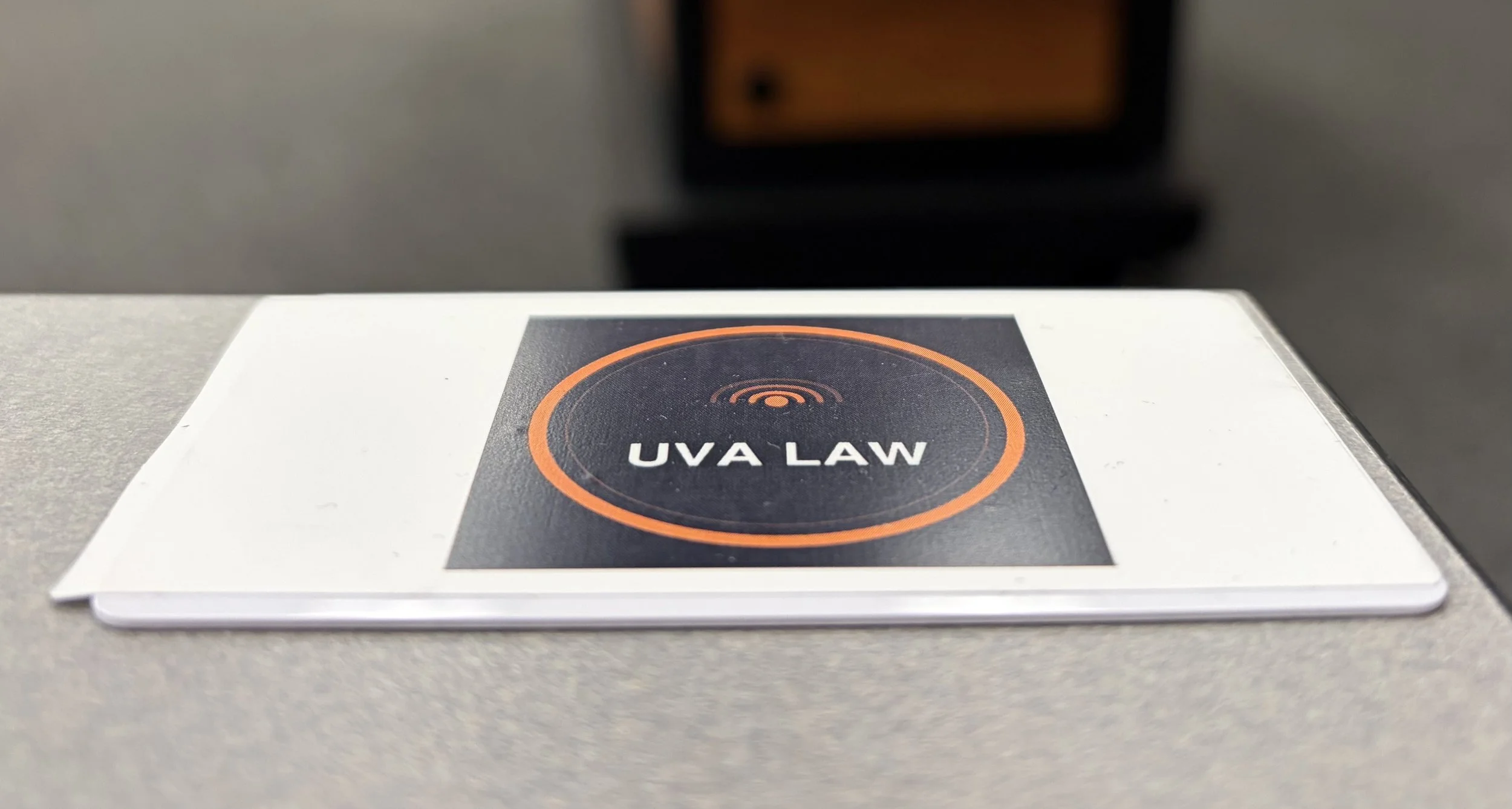
On Friday afternoon, August 21, the Law School student body received an email from Law IT, providing “a few reminders about recording. . .class attendance.” The email provided reminders regarding Qwickly attendance, including a reminder to “please check in at the start of every class.” After sparking confusion among 2L and 3L students, Law IT notified the student body that Qwickly Attendance was being utilized this semester for 1L courses only. The email confirmed that the attendance of 2L and 3L students would not be tracked via Qwickly.
Qwickly attendance is an attendance-taking and reporting platform that markets itself as “a powerful, customizable attendance solution for nearly every school needing to collect attendance data for regulatory compliance and to measure student engagement.”[1]
“There are two reasons we are piloting Qwickly for attendance keeping,” wrote Dean Leslie Kendrick in an email to the Law Weekly.
“First, the ABA requires law schools to publish and adhere to policies requiring regular class attendance.” At the Law School, students are required to attend a minimum of 80% of class sessions.[2] Dean Kendrick noted that, “[h]istorically, we have relied on instructors to monitor attendance, and that has some drawbacks: It can burden instructors, take away from class time, and generate questions about accuracy or inconsistency.”
Dean Kendrick said, “[s]econd, repeatedly missing class can be an early warning sign that a student is struggling. A professor or administrator checking in when a student’s attendance lags is more likely than later intervention to help them get support, as well as help them avoid significant academic or professional consequences that could compound their current situation.”
The administration plans to analyze the benefits offered by Qwickly for students and faculty. The determination of extending use of Qwickly for attendance keeping will depend on what lessons are learned during the pilot period.
However, 1L students have already reported encountering technical difficulties in recording attendance and an inflexible position from administration upon failing to record attendance, despite in fact attending class. This included technical difficulties observed by students during an intermittent WiFi outage on Thursday, August 27, which allegedly prevented some 1L students from recording attendance.
An email to Senior Assistant Dean for Academics Jason Dugas from one 1L, regarding failure to record attendance, was met with a response noting that “it is part of a student’s professional training to remember to adhere to requirements, so I hope you will draw the professional lesson from this experience.” Dean Dugas’s response also mentioned that “if you experience technical problems with the app or check-in tag, you should send a ticket to LawIT.” What qualifies as a technical difficulty (such as a WiFi outage) has not been expanded on, and it appears that extrinsic evidence of attendance will not be considered in the event of failure to record with Qwickly.
It remains unclear whether this policy implementation will be expanded to record future 2L and 3L attendance. However, both 2L and 3L students have expressed frustration with this policy.
Class Recordings Availability Window
The administration implemented a new policy on the availability of class recordings. Previously, professors had nearly complete discretion over whether or not to record their classes, and how widely those recordings were available. Now professors just have the choice of whether or not to record their class. The administration has created a uniform policy on the availability of any class recordings a professor makes. All recordings will be available for two weeks after the class before removal.
The administration intends for this change to address two goals. First, according to an email from Vice Dean Deeks, they “want to ensure that students have equal access to class recordings.” There was some confusion under the prior system as different professors used different policies for their courses, so this certainly standardizes the issue and will continue to put all students on the same playing field. That said, given the variety of subject matter and teaching styles used by professors, the change will restrict their ability to tailor the course policies to the particular course.
Second, the administration found that students “rely on recordings as a substitute for processing, distilling, and synthesizing information,” and that doing so “can cause real stress if they wait until the end of the semester to view all of the recordings.” When the administration was contacted for comment on how this decision was made and how the efficacy of the change will be measured, the administration deferred to the email from Vice Dean Deeks. Neither the email nor the follow-up shared the details of the decision-making process. How the administration collected data about students becoming dependent on recordings is unknown. Similarly, it is uncertain how the administration will measure the results of the change to evaluate its eventual success or failure.
ID Badging Building Access Requirement
The administration has also increased security around the Law School by requiring students to badge into all entrances other than the main doors in Clay Hall. The school also added a welcome desk by the unlocked doors.
The administration shared that the Law School regularly hires consultants to evaluate the security of the building, and the review recommended the changes as a result of the large number of exterior doors and recent “high-profile campus incidents happening across the country in recent years.”
The change was communicated to students via signage around the building and an email earlier in August. While students have taken some time to adjust to the change, other than the extremely loud alarm on the door by Scott Commons and a few doors getting stuck or jammed, there has not been any true negative impact yet in the semester. Additionally, the new people manning the front desk are a welcome addition to the school with their kind manner and bowls of candy. While every change requires an adjustment period, enhancing building security through badge scanners will prepare the students for scanning into law offices after graduation.
Additional Administrative Changes
Dean Kendrick confirmed that, barring some “unforeseen technological change or circumstance,” the administration does not expect to make “substantial changes to exams this year” and hopes that exams this year will be more or less like last year.
This is sure to be welcome news for students who expressed concern about further exam modifications.
Moreover, Dean Kendrick highlighted additional administrative changes and infrastructure projects that the administration completed over the summer. Notably, the administration moved the fall semester 1L grading deadline to earlier in January to aid 1L students with their job searches. As the recruiting timeline continues to advance earlier into the first semester, the previous grading deadline was a source of anxiety for some 1L law students participating in both firm and public service recruiting.
In addition, the Law School completed infrastructure maintenance projects around the Law School, placed new donated artworks, and expanded offerings in the Sidley Austin Café and the 24/7 micro-market, including a hot bar and sushi.
[1] https://www.goqwickly.com/attendance/.
[2] Under Law School Academic Policies and Procedures, “regular and punctual in-person class attendance is part of each student’s required work in courses. While instructors are authorized to require a higher standard of attendance, students are required to attend 80 percent of class sessions at a minimum.” https://www.law.virginia.edu/policies/i-academic-policies-and-procedures-4.
Authors: Andrew Moore & Sam Koeppel