
Listening to Justice Barrett
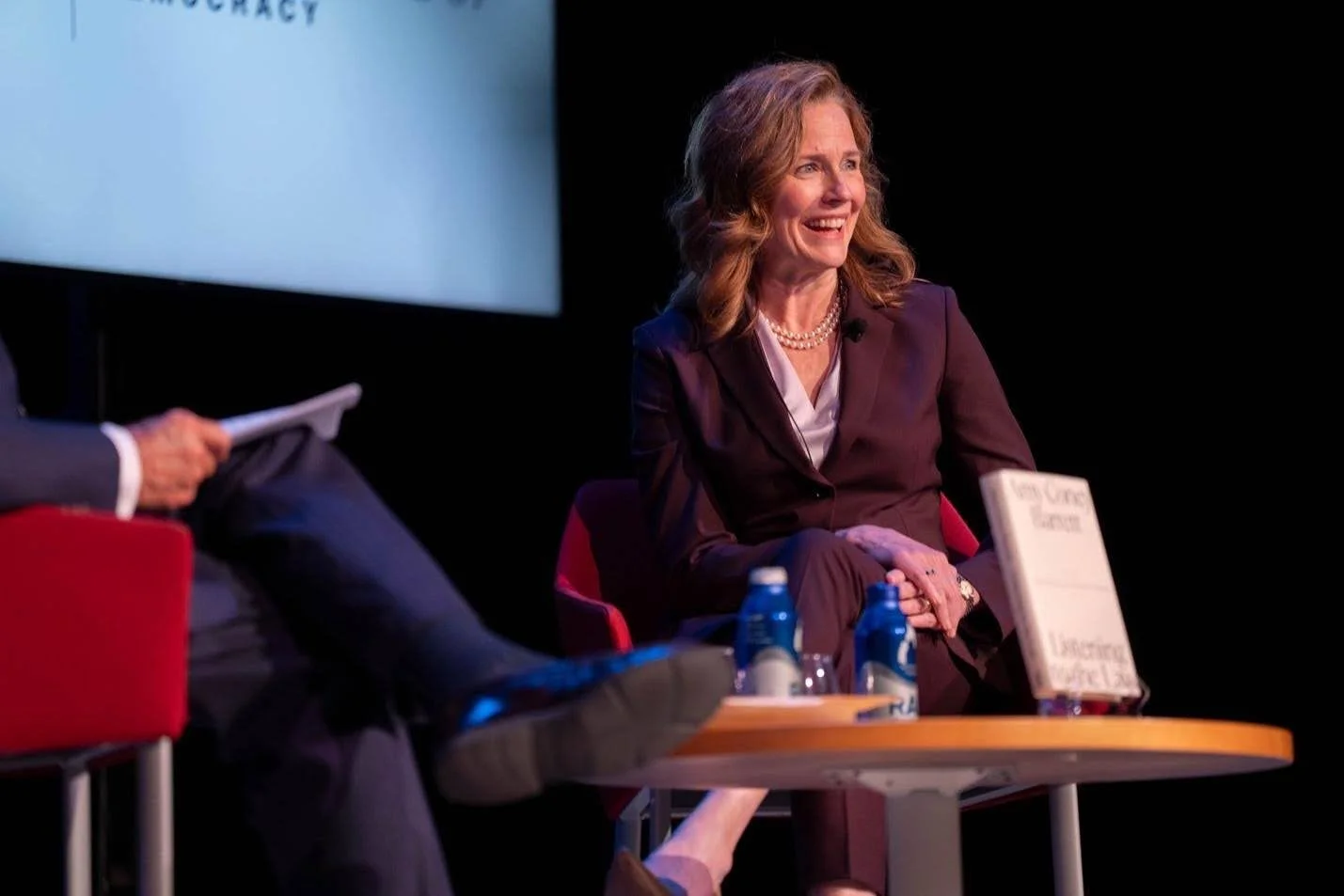
The University of Virginia hosted Justice Amy Coney Barrett of the U.S. Supreme Court for a conversation on Thursday, September 19. The School of Law and the Karsh Center of Democracy sponsored the event at the Culbreth Theatre. Justice Barrett was in town for the latest stop on her book tour promoting her debut book, Listening to the Law: Reflections on the Court and Constitution.
Before the event started, law students, undergraduates, and faculty filled Culbreth in anticipation. While the event required a higher degree of security than even the law school has yet adopted, students remarked on the smoothness of the admission process. Emma Hall ’28 said that “getting in was really easy,” which was an accomplishment for the level of security required for Justice Barrett’s presence. Other students concurred. While chatting among the other students before the chat began, Lauren Johnson ’28 said, “So far, I’m having a great time,” while Muthu Meenakshisundaram ’29 opined that the event was “exquisite.” It is worth noting that despite the event being referred to as a “fireside chat,” no fire was to be seen, though this did not dampen the students’ spirits.
The event began on time with Melody Barnes introducing both Professor and Former Dean John C. Jeffries Jr. ’73 and Justice Barrett before Professor Jeffries began the discussion. Professor Jeffries started by asking the Justice about her “dry” and “witty” writing style, though he was quick to clarify that he meant “dry” in a complimentary sense. Justice Barrett replied that she learned some of her style from her clerkship with Justice Scalia, who “was famous for his quick wit and turns of phrase.” That said, the conversation quickly turned from the lighthearted to questions of legal analysis and methodology.
Justice Barrett clarified that while she learned some of her writing style and legal interpretation methods from Justice Scalia, she does vary from his interpretations on some points. Notably, while Justice Scalia pioneered a focus on textualism to the exclusion of legislative history, Justice Barrett indicated some daylight between their positions by saying that, “I don’t actually think legislative history is verboten.”
Credit: Sanjay Suchak
Professor Jeffries then steered the conversation towards the major questions doctrine. Justice Barrett explained her position through an extended metaphor of parents employing a babysitter to make sure kids have fun. In her metaphor, small expenses like pizza and a movie would be allowed, while having fun by planning an expensive trip would not be allowed unless the parents had said, “Here’s the schedule of train times.” While focused on its analogy for the major questions doctrine, the metaphor may also indicate that Justice Barrett enjoys train travel, and by extrapolation may be a fan of E.M. Frimbo stories, but that is conjecture. Regardless, Professor Jeffries acknowledged that it was the best description of the major questions doctrine that he had heard, but tonally he did not seem entirely convinced.
Beyond the nuances of legal analysis, Professor Jeffries next asked about her experience on the Court and the Court’s role in government and society. Justice Barrett declined to answer in detail about her thoughts on some of the President’s comments about the Court and about Court reform proposals currently being proposed. She did, however, convey that she hopes the American people “understand the Court isn’t the same thing as Congress.” Furthermore, she asserted that “the Court needs to be aware of what’s going on in the country . . . but the job is to apply the law.” Most importantly, she reiterated calls to “be friends [and] work productively with those who see things differently” and “to work to find common ground.” That said, she acknowledged the trials of the time by describing that “it’s a lonely job” because of the security measures in place around the Court.
After Professor Jeffries concluded his questioning, selected students asked the Justice questions. Two undergraduates and one law student asked a total of five questions that ranged from asking about her typical day to her favorite and least favorite aspects of being on the Court. It was undoubtedly an incredible opportunity for the trio; how creative they were allowed to be with the questions is unknown. However, other law students after the event were curious why only three students got to ask questions instead of spreading the five questions among five students. Furthermore, attendees felt that while Professor Jeffries asked questions that finely balanced inquiry with the politeness required for the event, some of the student questions erred on the generic or milquetoast side of the spectrum.
That said, most students said they enjoyed the event afterwards. Whether it was a commercial success or not is uncertain—as of shortly after the event, only about thirty of the ninety-six copies of Listening to the Law had been sold for thirty-two dollars apiece for a revenue of $960 before expenses.
Author: Andrew Moore ’28, cwb5ex@virginia.edu