
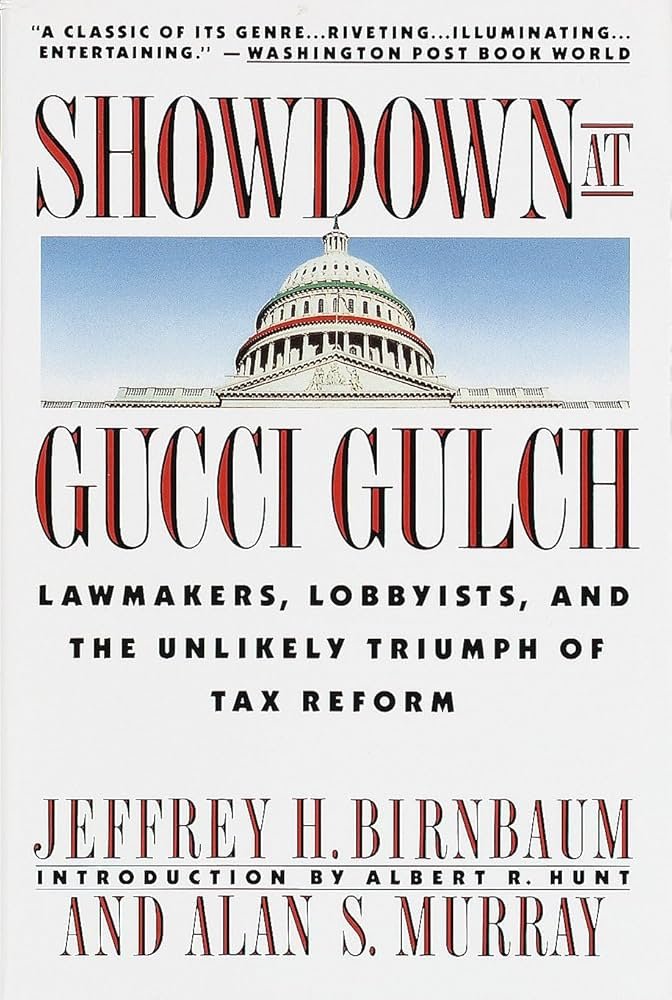
Source: Knopf Doubleday Publishing
Showdown at Gucci Gulch by Jeffrey H. Birnbaum and Alan S. Murray is a tour de force of tax law and political history arguably without equal in recent literary history, though D.P. O’Brien’s eight volume History of Taxation surely merits examination in the category. The on-the-ground style reporting, the authors’ clear appreciation of the politics of tax law, and the thrilling narrative make for a riveting tale of tax credits, loopholes, and special interests.
As with any book about tax law, the principle challenge is to not provide too much extra context or detail unrelated to tax law; tax law is one of the most engaging subjects about which to write and yet some authors may be tempted to break up exhilarating discussions of deductions and exclusions with mind-numbing anecdotes or quotidian personal details to color the portraits of the main actors. Thankfully Birnbaum and Murray are sensible enough to let the tax law narrative stand on its own for the most part. While the necessity of explanations of such widely known subjects as the Gramm-Rudman-Hollings law and rapid depreciation write-offs is questionable (surely everyone is already well aware of these), the quality is not. When the authors do interject the odd anecdote here and there, whether how Chairman Rostenkowski’s three airline stewardess daughters motivated his advocacy for parents to be able to ride tax-free on standby via their kids in the airline industry, or how transition rules were used to fund football stadiums, it is typically to good effect.
The only critiques that can be leveled at Showdown at Gucci Gulch are its brevity and the fact that it is sadly not required reading in Federal Income Tax class. While the lobbyists and special interests feature prominently in the title, their maneuvers are lacking in commensurate detail for the most part. Glimpses into the world of Charls E. Walker and the ‘Carlton group’ entertain and educate the reader, but they are abbreviated thumbnail sketches relative to the more expansive profiles dedicated to other major players like Chairmen Rostenkowski and Packwood. For “a virtual fourth branch of government,” they sadly get less attention than their legislative counterparts.
The legislative and executive actors understandably dominate the narrative and the special interests’ ultimate existence on the periphery is unquestioned, but a bit more attention to their machinations beyond the delightful sections on economic research consultants and high-priced tax attorneys would have only improved the book. In particular, the oil and gas lobby merited more airtime. Robert Caro described the schemes of oilmen and wildcatters to great effect in The Years of Lyndon Johnson, particularly in chapter twenty of The Path to Power (The Dam). Given that the oil industry was one of the more successful at emerging from tax reform relatively unscathed, a more thorough examination of their efforts and Secretary Baker’s influence would have made for a fun addition to the book.
The significance of the changes and the demonstration of legislative history in the book would also make it a fun companion piece to Federal Income Tax class.
If you enjoy the page-turning reporting style of Showdown at Gucci Gulch, you may also enjoy Barbarians at the Gate, another hectic tale of the 1980s, and The Man Who Ran Washington by Peter Baker and Susan Glasser, a biography of the same Secretary Baker who features prominently in Showdown. If you enjoy the intersection of business, politics, and law, you may also enjoy Only the Rich Can Play by David Wessel, (though it is not quite as focused or as exciting, it is still a good book about the implications of tax law) and The Caesars Palace Coup by Max Frumes and Sujeet Indap, a rollicking page turner about restructuring law and private equity. For further reading suggestions or if you are interested in discussing these or other similar titles, feel free to write a letter to the author.
__
Staff Editor — Andrew Moore ’28
cwb5ex@virginia.edu