
Spanberger Shuffles UVA Board of Visitors in Flurry of Resignations, Nominations
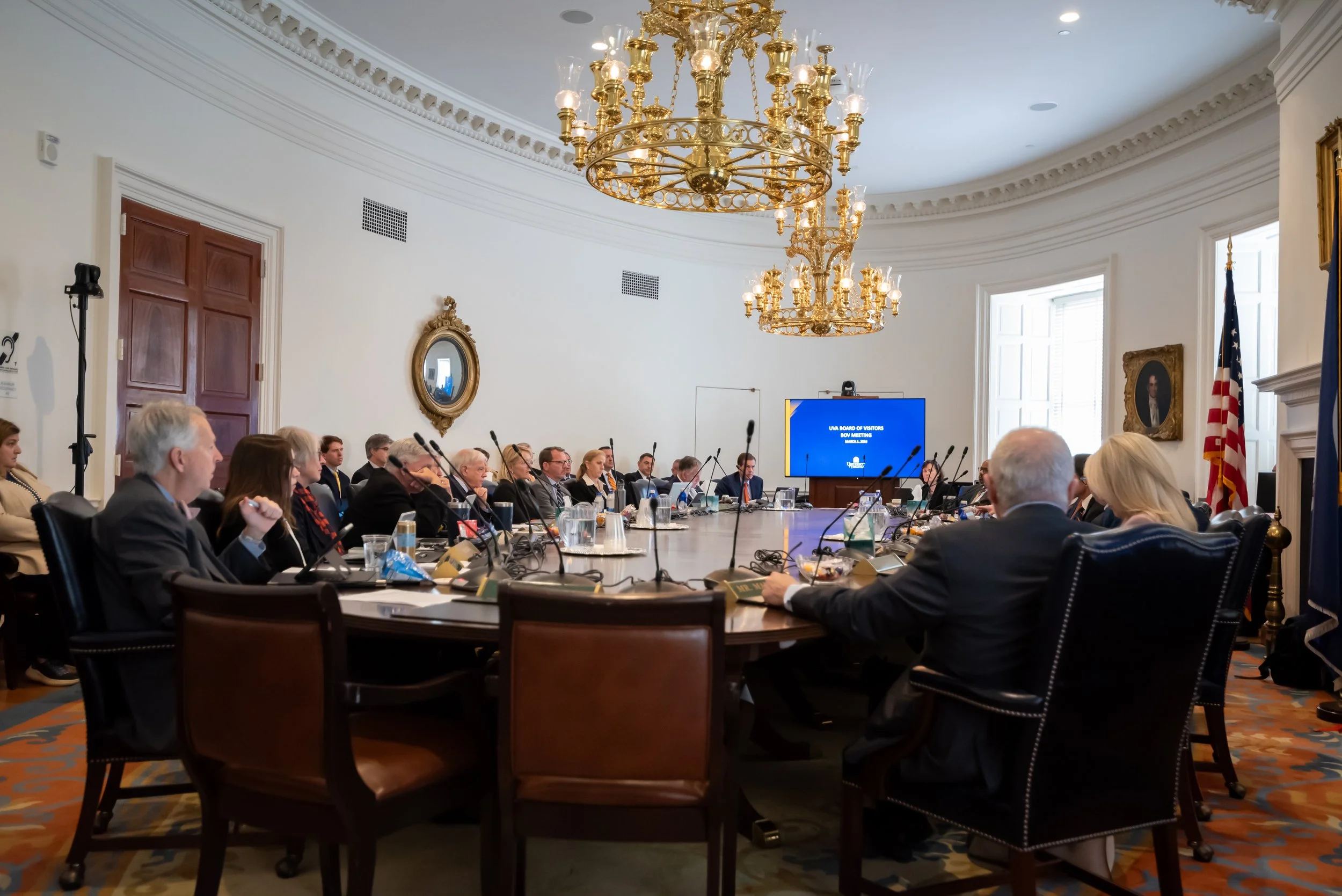
Source: Benvin Lozada from the Cavalier Daily
Abigail Spanberger (D) was sworn in Saturday as Governor of Virginia, and had begun reshaping the leadership of Virginia’s public universities even prior to her inauguration. For the University of Virginia’s Board of Visitors, a handful of Virginia Law alumni are out, with a different handful of Virginia Law alumni nominated to replace them. These resignations and nominations are another chapter in what has been a long political saga involving outgoing Governor Glenn Youngkin and the Trump administration, but this latest set of changes raises two critical questions: How will the Law School be represented on the Board in proportion to the lesser professions (like medicine or engineering)? And what even is a Board of Visitors?
Regarding the first question, law students and alumni can rest assured that, if Governor Spanberger’s nominations are confirmed by the Democratic-majority General Assembly, UVA Law representation will increase on the Board of Visitors. Prior to the changes, the Board had only twelve of seventeen seats filled, with five of those twelve possessing a law degree, and only three being UVA Law alumni. All three of them—Rector Rachel Sheridan (Col ’94, Law ’98), Vice Rector Porter Wilkinson (Law ’07), and Douglas Wetmore (Law ’91)—were among this weekend’s resignations (which, according to the Washington Post, came at the request of Governor Spanberger). Governor Spanberger understood the importance of keeping lawyers on the Board of Visitors, including five lawyers among her ten nominees, four of whom are graduates of UVA Law. For those keeping score at home, that would result in a full board of seventeen voting members, with seven being lawyers and four being UVA Law graduates. While this represents only a small step towards a majority of the board, it is important to remember that law students make up only 3.6% of total University enrollment.
The four UVA Law alumni nominated for the Board by Governor Spanberger are Carlos Brown (Col ’96, Law ’99), Robert Byron (Col ’73, Law ’76), Elizabeth (Liz) Haile Hayes (Law ’78), and Moshin Syed (Col ’02, Law ’08). Carlos Brown served as president of BLSA while at the Law School and was president of the University student body while an undergraduate. He began his legal career as an associate at McGuire Woods LLP but has spent the bulk of his career in a variety of roles at Dominion Energy, where he is currently President and Chief Administrative and Projects Officer. He previously served on the Board of Visitors from 2021 until June of 2025. Robert Byron spent his legal career first in real estate, construction, and development, before founding his own real estate investment firm, Blue Vista Capital Management. Liz Haile Hayes is a retired partner at Akin Gump Strauss Hauer & Feld LLP, where she headed the firm’s Communications Practice. Moshin Syed has worked on Capitol Hill for Senator Bill Nelson (D-FL), for various congressional committees, including the House Committee on Transportation and Infrastructure, and has spent the bulk of his legal career in the U.S. Department of Transportation, where he was most recently Chief of Staff. He also worked early in his career at Washington law firms Arnold & Porter Kaye Scholer LLP and Akin Gump Strauss Hauer & Feld LLP.
Having established a basic familiarity with the attorneys exiting and those nominated to fill vacant seats, we return to our second question: What is a Board of Visitors? According to its website, the Board of Visitors “serves as the corporate board for the University of Virginia, and is responsible for the long-term planning of the University,” which apparently includes approving budgets and policies and preserving the University’s traditions. But why is it called the Board of Visitors and not the Board of Governors or Trustees or Regents, or even the Board of Planners and Preservers? Who or what are they visiting?
As it happens, the “visitor” terminology is unique to Virginia universities, with universities in other states more often opting for one of the aforementioned names. Like many things in Virginia, this is not new, and like any good law student, we can turn to Black’s Law Dictionary to quickly get at the heart of the matter: “A person appointed to visit, inspect, inquire into, and correct corporate irregularities.” A peek at an older edition of Black’s reveals even more context: “The term ‘visitor’ is also applied to an official appointed to see and report upon persons found lunatics by inquisition, and to a person appointed by a school board to visit houses and see that parents are complying with the provisions in reference to the education of their children.”
Perhaps Virginia has retained “Board of Visitors” to emphasize lunacy, or perhaps to emphasize parental involvement in education, but it is most likely because of Virginia’s keen interest in preserving history. In fact, the Board of Visitors has carried its name for longer than the University has been called the University of Virginia. Thomas Jefferson’s own notes from the Board’s first meeting in 1817, signed by himself, James Madison, and James Monroe, open: “At a meeting of the Visitors of the Central College [the entity that later became the University] . . . .” Of the seven original Visitors, four studied law (although two—Joseph Cabell and James Madison—never practiced). Though there is no formal requirement for a high proportion of UVA Law alumni on the Board, history makes it clear that the founders intended for lawyers to run the place. This weekend’s developments reaffirm that tradition and remind law students that a seat on the Board of Visitors remains an achievable career possibility.
__
Philip Bishara ’28
xte2fx@virginia.edu