
Snow-Drought Impacts Western U.S., Business-As-Usual in the East
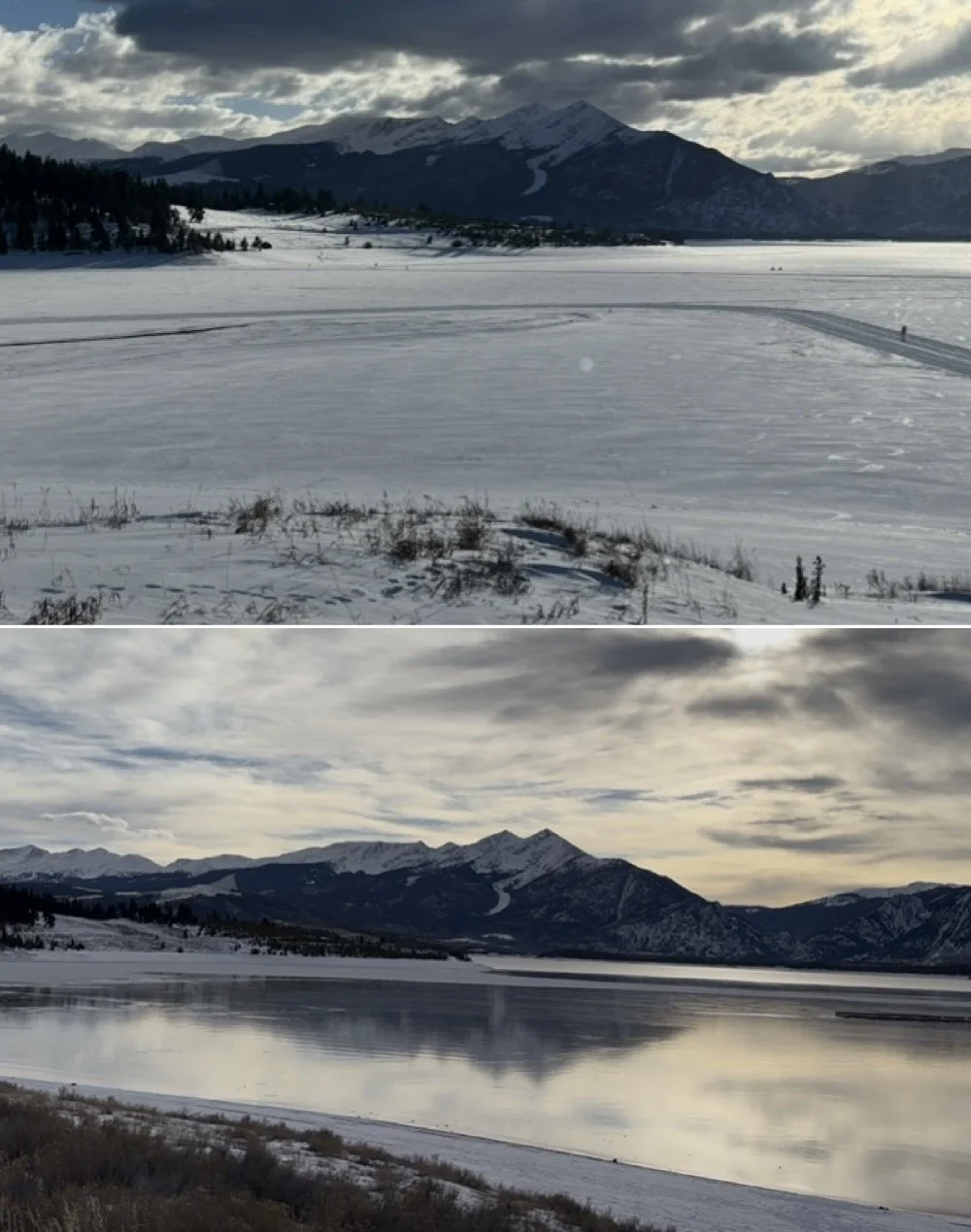
Dillon Reservoir in Summit County, CO in Jan 2025 (top) and Jan 2026 (bottom). Source: Author
Members of the Law School community returning home for winter break may have noticed something rather peculiar upon their arrival to certain regions. While much of the eastern United States was looking very White Christmas (1954), other areas of the world looked a little more Mad Max: Fury Road (2015).
Much of the Midwest and Northeast has received normal-to-higher levels of snowfall for this time of year, despite a lower overall amount of precipitation. [1] In these regions, this pattern of cold weather is in no danger of letting up any time soon. [2] For first-year students whose finals schedules were impacted by the early December storms, this may not come as much of a shock. Weather reports from other parts of the United States, however, have been telling a different tale.
The western U.S., including the Rocky Mountains and Sierra Nevada Mountains, have experienced notably lower snow levels than is typical for this time of the year. Large swathes of the west have reported conditions of snow-drought, meaning that the amount of water contained in the region’s snow pack is well below average. [3] Weather-dependant businesses—especially those linked to the ski and snowboard industry—have been attempting to rapidly adjust. In Colorado, the deficiency was so severe that the International Ski and Snowboard Federation cancelled the opening race of the men’s Alpine downhill season—part of an event that has been held in Beaver Creek, Colorado for the last 28 years. [4]
The lack of snow has not been a uniquely American experience, either. Several European countries have reported a lower-than-usual snowpack this winter. Italy and Austria, in particular, have reported that their alpine snowpack is one-fifth to one-quarter lower than would typically be expected for this time of year. [5]
For some, this lack of frosty weather may not be entirely unwelcome. The rising temperatures have made for a relatively mild winter in the Southwest and parts of the Mid-Atlantic. [6] These regions enjoyed comparatively mild temperatures and low snow loads over winter break. Many residents of these areas, which are typically less well suited to handling large snow loads, will have reaped the short-term benefits of the lovely weather.
However, this winter’s weather patterns are indicative of the larger, drier elephant in the room. Experts have cited steadily rising temperatures as a cause for this winter’s odd weather patterns. [7] As global warming further exacerbates the issue, we can expect not only a higher frequency of events such as droughts, heat waves, and other extreme weather events, but we can also expect them to increase in severity. [8] In short, as time marches on, we will likely see the heat waves get hotter and the cold snaps get colder. The year-to-year consequences of snow-droughts will therefore become more extreme.
Less snow means less snow melt, resulting in less water for lakes, streams, and reservoirs. Less water in reservoirs means less water for irrigation, which means a poorer growing season for farmers, resulting in lower crop yields which leads to concerns for both public health and the U.S. economy. However, these consequences can turn even more violent. A mild snow season inevitably gives rise to a more catastrophic fire season in states like California, Nevada, Idaho, and Colorado. When low reservoir levels combine with dehydrated forests, fire fighting and forest management teams face millions of acres of ready tinder with insufficient means to manage it.
Whether you have been dreaming of a winter draped in white or millennial beige, the impact of this winter’s weather events will likely become apparent to us all before long.
[1] https://www.weather.gov/media/akq/December2025_WeatherSummary.pdf#:~:text=Overall%2C%20the%20relative%20warmth%20observed%20during%20the,daily%20temperature%20records%20were%20tied%20or%20broken.
[2] https://weather.com/forecast/news/2026-01-17-parade-snowy-systems-snow-wind-extreme-cold-east
[3] https://www.drought.gov/drought-status-updates/snow-drought-current-conditions-and-impacts-west-2026-01-08
[4] https://www.reuters.com/sports/cancelled-beaver-creek-downhill-switched-val-gardena-2025-12-05/
[5] https://www.onthesnow.co.uk/news/europe-snow-report/#:~:text=Snow%20conditions%20in%20Italy%20are,last%20week%20brought%20widespread%20snowfalls.
[6] https://www.outdoors.org/resources/amc-outdoors/conservation-and-climate/wheres-winter-mid-atlantic-edition/#:~:text=The%20Mid%2DAtlantic%20region%20includes%20southern%20New%20York%2C,Philadelphia%2C%20Pennsylvania%20experienced%20a%20715%2Dday%20%E2%80%9Csnow%20drought%E2%80%9D
[7] https://coloradonewsline.com/2025/12/01/winter-storms-wheres-the-snow/#:~:text=Rising%20temperatures%20have%20led%20to,decrease%20in%20the%20spring%20snowpack.
[8] https://science.nasa.gov/climate-change/extreme-weather/
__
Emma Lawson ’28
hzk2ny@virginia.edu