
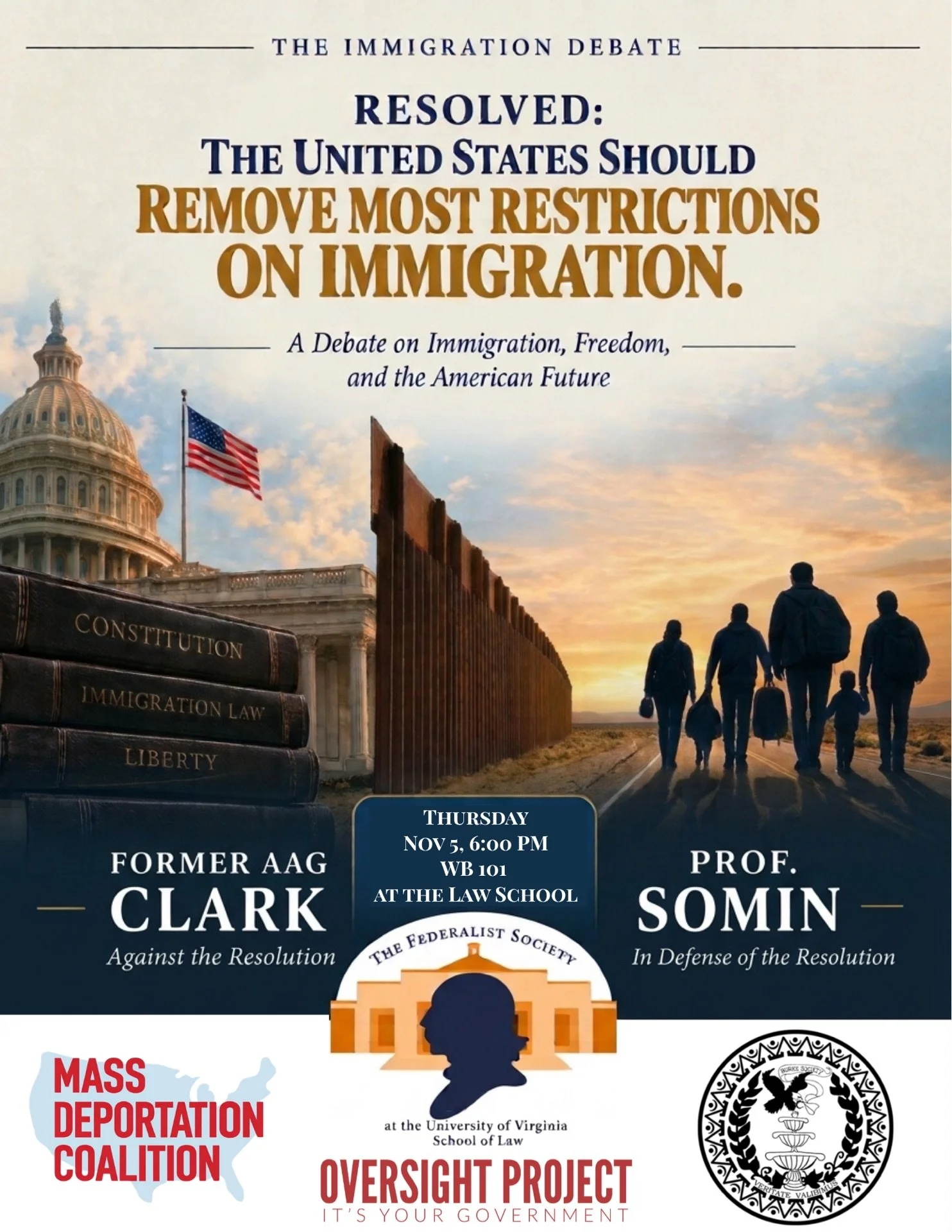
On November 5, 2026, the Federalist Society hosted a debate on one of the country's most contentious political issues: immigration. Rather than debate where to draw the line, however, the evening's resolution asked whether there should be a line at all. The resolution read: "The United States should remove all restrictions on immigration."
Arguing in favor was Visiting Professor Ilya Somin of George Mason University's Antonin Scalia Law School. Opposing him was Jeff Clark, former Assistant Attorney General for the Department of Justice's Environment and Natural Resources Division. Rick Eberstadt ’17 moderated the debate.
The speakers approached the resolution from different starting points. For Professor Somin, freedom of movement is a fundamental liberty. For Mr. Clark, immigration restrictions are essential to preserving America's culture, sovereignty, and democratic character.
Professor Somin opened with the moral case for immigration, arguing that individuals should be free to cross borders regardless of birthplace, subject to narrow security exceptions. Deporting someone fleeing persecution, he suggested, is akin to “sending a person back into a burning building.” He also warned that immigration enforcement can harm American citizens through wrongful detentions and racial profiling.
Professor Somin argued that the benefits of immigration extend beyond individual liberty to the economy as a whole. Allowing people to move to more productive economies, he contended, would generate enormous gains in global GDP while encouraging innovation. He also challenged the notion that a nation, like a private home, enjoys an absolute right to exclude outsiders. Taken to its logical conclusion, Somin argued, that analogy could justify government restrictions on speech and other liberties.
Mr. Clark offered a different vision, emphasizing the preservation of America's Anglo-American traditions and invoking biblical principles. A functioning republic, he argued, requires a common culture, and assimilation takes time. He also challenged whether Somin's proposed terrorism exception could work without an effective screening system, and questioned whether that screen would look any different from the systems already in place.
Clark further cited statistics that immigration's economic costs fall disproportionately on vulnerable workers and new immigrants themselves. Invoking economist Milton Friedman, whom he referred to as a "hero to many," he argued that unrestricted immigration and a generous welfare state cannot coexist. Clark also pointed to a backlog of roughly one million tips at ICE as evidence that the current enforcement system is already overwhelmed and removal of all restrictions isn’t feasible.
Source: Federalist Society
In rebuttal, Professor Somin argued that America has accommodated much larger immigration waves before and that immigrants still have powerful incentives to assimilate, such as the incentive to learn the language. As for the ICE backlog Clark cited, Somin proposed a solution that would certainly clear the queue. Abolish the agency. The money, he suggested, would be better spent on local police departments combating crime more broadly.
Further, Somin pointed to Switzerland's comparatively large immigrant population as evidence that immigration need not undermine prosperity. He also argued that concerns about crime and terrorism are greatly exaggerated, citing statistics that immigrants are less likely to commit crimes than native-born Americans and that Americans are more likely to be struck by lightning than killed in an immigrant terrorist attack.
Turning to economics, Somin noted that undocumented immigrants are already excluded from many welfare programs and argued that existing American workers have no inherent right to protection from labor market competition. In a rather curious turn, Somin had some Friedman quotes of his own, noting that the economist had actually expressed a preference for illegal immigration since undocumented immigrants generally cannot access welfare benefits.
Mr. Clark was unconvinced. The Constitution, he argued, imposes no obligation to admit immigrants, and screening based on nationality does not necessarily constitute racial profiling. Clark was less impressed by the Swiss example, pointing out that the country maintains immigration restrictions of its own.
The moderated discussion brought the philosophical differences into sharper focus. Somin compared immigration restrictions based on birthplace to apartheid, while Clark emphasized the government's constitutional authority over citizenship. Asked about assimilation, Clark argued that earlier European immigrants faced fewer cultural barriers. Somin countered that assimilation happens naturally and questioned whether preserving a particular culture should be the government's responsibility at all.
The debate also produced a moment of academic territoriality. When Clark attempted to explain the Tiebout Model in relation to open borders, Somin responded to Clark’s conclusion, saying, "I'm an academic expert on the Tiebout Model, and it's actually the exact opposite." A thoroughly professorial way of saying, "That's not how that works."
The final exchanges returned to immigration enforcement. Clark called for stronger enforcement, highlighting that even if there are constitutional violations, there are remedies available to citizens, while Somin warned that such remedies have rarely been used in practice, and ICE Agents operate with qualified immunity.
By the end of the evening, America's immigration debate remained unresolved. But the debate illustrated that immigration policy involves more than economics or border security. At its core lies a disagreement over the obligations a country owes to those born outside its borders and how far it may go in favoring those born within them.