
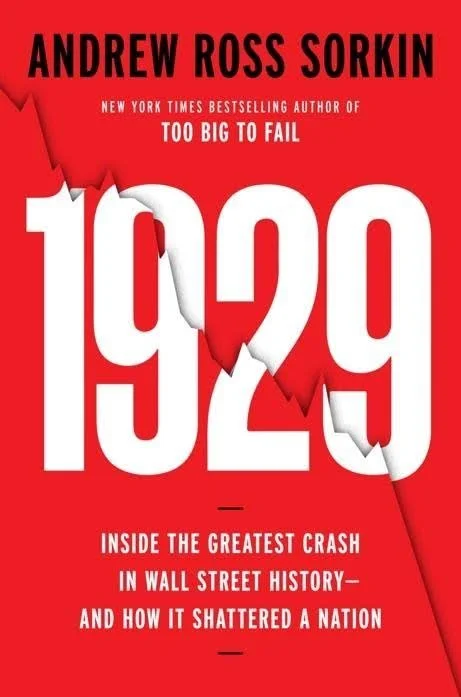
Andrew (no relation) Ross Sorkin’s ‘1929: Inside the Crash’ is an enjoyable and lightweight history of the 1929 financial crash and the preceding and succeeding years. One of the highlights is the structure which facilitates a fast pace and keeps the story moving. It reads like a classic history ‘beach read’ (not that I get why people would read on a beach or go to a beach for that matter). On the other hand, there were times when additional detail could have given more depth to the narrative. All in all, ‘1929’ is a pleasant enough light read about an educational era of history that parallels the modern era in many ways.
From an overall perspective, ‘1929’ is a perfectly fine history book about the 1929 financial crash. Sorkin establishes his cast of characters from Senator Glass to Lamont to Mitchell with a series of thumbnail sketches. These vignettes establish their general outlines even as later it does become more or less a series of names getting up various financial shenanigans. The history preceding the crash ably shows the overconfidence endemic of the age. ‘1929’ lists how the experts of the time all saw the nearly decade-long bull market as proof that the market could only go up and evidence for investing in ever more speculative schemes and industrial concerns. The lessons of prudence and caution before investing in businesses that struggle to turn a profit retain their merit regardless of the age. While the book is about the history and so does not put much time into explicitly drawing the parallels, it does demonstrate similarities between the overconfidence of 1929 and the artificial intelligence propagandists who do not let a lack of profits or cold, hard cash obscure their whimsical dreams of future growth. Regardless, it is a quality history book.
Perhaps the best or most unique part of the book is its structure. The sections within chapters are typically between one and three pages. These make it very easy to pick up and read a little bit here and there. They also encourage the reader to keep going quickly since each additional section seems like a light lift. This speed helps ‘1929’ read with the speed of a book of fiction. Most history books employ lengthier sections within chapters, so this was an interesting change of pace.
Source: Viking Press
While ‘1929’ is an interesting and educational read, where it falls short is in depth and uniqueness. By covering such a variety of characters and storylines over the course of several years in a mere 444 pages, ‘1929’ is ultimately unable to dig as deep into the material as the highest tier of history books tend to do. The anecdotes have a bit of detail (and the one featuring Judge Learned Hand is quite entertaining!), but the detail, like the book, is scattered hither and thither instead of being concentrated on a particular narrative or character. While it is easier to delve into detail when a history book has a single narrative or main biographical subject, as in ‘The Years of Lyndon Johnson’ and ‘The Power Broker’ by Robert Caro or David Chandler’s famed 1966 tome ‘The Campaigns of Napoleon’, Sorkin still could have followed the models of ‘Big Trouble’ by J. Anthony Lukas, ‘A Short History of World War I’ by the great James L. Stokesbury, Peter Hopkirk’s thrilling ‘The Great Game’, or the thoroughly exciting ‘The Maryland Board of Public Works: A History’ by Alan Wilner. Admittedly, Stokesbury, Hopkirk, Lukas, and Wilner set a high bar for telling globe-spanning tales in detail, but they do show it is possible. Not only do they show that balancing a maximal scale with intricate detail is possible, but they demonstrate that it is necessary for a truly masterful history book. Whether by describing the exhilarating legal orations in ‘Big Trouble’, the bureaucratic wrangling within and across imperial general staffs in ‘A Short History of World War I’, the adventures, climbs, and secret instructions in ‘The Great Game’, or the clause-by-clause legal analysis in ‘The Maryland Board of Public Works: A History’, they evidence that the detail is what separates the classics from the rest of the genre. Sorkin could have elevated ‘1929’ with details of the particular financial maneuvers and stratagems taken by his ensemble cast.
If the reader is hoping for a more detailed history, then they are best to keep looking further afield. That said, it is a perfectly competent history book and ‘1929’ is good for anyone looking for a quick read about the 1929 financial crash.
Author: Andrew Moore ‘28, cwb5ex@virginia.edu