
On Thursday, Nov. 12, UVA Law hosted the 98th Annual William Minor Lile Moot Court finals in Caplin Auditorium.
Before a panel of Nicole G. Berner of the U.S. Court of Appeals for the Fourth Circuit, Kevin G. Ritz of the U.S. Court of Appeals for the Sixth Circuit, and Peter K. Killough of the Supreme Court of Maryland, as well as a packed crowd of students and faculty, two teams of finalists delivered oral arguments.
Dan Cummins ’27 and Shree Balaji ’27, representing Thomas Miller, the appellant, and Caroline Davisson ’27 and Salaar Khan ’27, representing FantasyMavens.com, the appellee, litigated two discrete issues:
Can a court in Lile exercise personal jurisdiction over FantasyMavens?
Is Miller a consumer under the Video Privacy Protection Act (VPPA)?
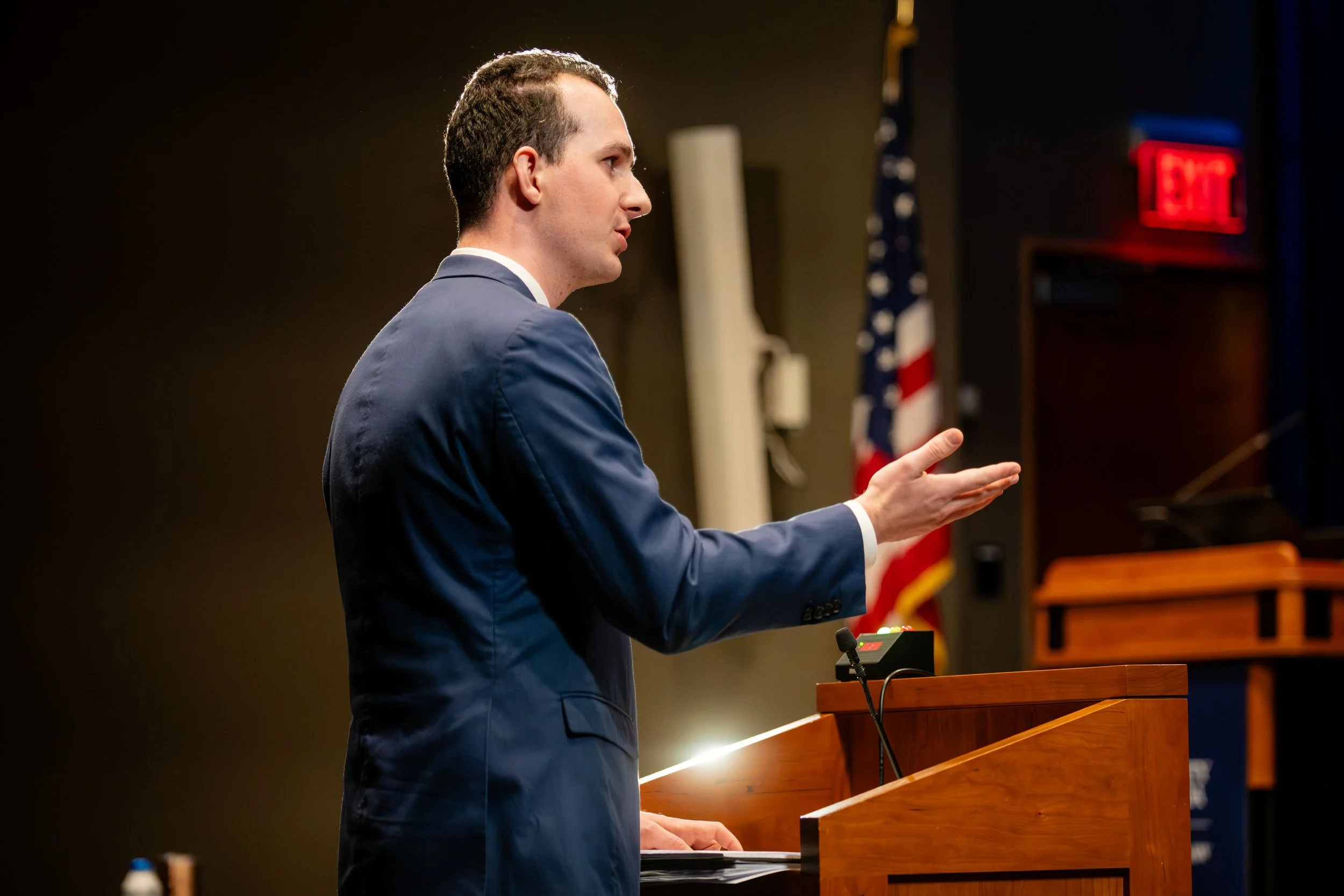
Justice Berner said, “You may proceed,” and the timer started for Dan Cummins, counsel for the appellant. Cummins handled the jurisdiction issue, asserting that a court in Lile may exercise personal jurisdiction over FantasyMavens.com. Cummins noted that under either the traditional purposeful availment test or the Calder Effects test, Lile may exercise personal jurisdiction over FantasyMavens.com. Almost immediately upon addressing the purposeful availment test, Cummins was bombarded with questions from the bench. Judge Berner directed the first question at Cummins, with Judge Ritz following her lead, needling Cummins to locate where the jurisdictional line is for websites like FantasyMavens.com that are merely available online in Lile, but lack a physical presence within the forum state and do not intentionally direct business to the forum state. Judge Ritz repeatedly emphasized notions of fair play and substantial justice, as derived from International Shoe Co. v. Washington, 326 U.S. 310 (1945), in questioning Cummins. But Cummins deftly batted away and addressed each question, and continued with his argument. He next addressed the alternative ground for jurisdiction, the Calder Effect Test, alleging that FantasyMavens.com had directed its contacts at the forum through its newsletter and website pixels it deployed on Thomas Miller’s browser. With his time dwindling, Cummins concluded his argument and handed the argument to his partner Shree Balaji.
Source: Benvin Lozada
Balaji addressed the statutory interpretation question of whether Miller was a consumer under the VPPA, which bars video tape service providers from knowingly disclosing their consumers' personally identifiable information. The statute specifically protects any renter, purchaser, or subscriber of goods or services from a video tape service provider. Under the facts, Miller subscribed only to a text newsletter, not to video content. Balaji first sought to convince the judges to adopt a broad understanding of “goods or services” for purposes of the VPPA, and that the newsletter in particular constituted a good or service. Balaji appealed to the plain, ordinary meaning of “goods or services” and employed the canons of construction to flesh out the meaning in the context of the VPPA. Balaji encountered pushback from the bench, but was able to nimbly counter each question from the judges as time expired for the appellants.
With the end of the appellant’s oral argument, Salaar Khan, representing the appellee, FantasyMavens.com, walked to the podium. Khan sought to convince the judges that FantasyMavens.com’s minimum contacts were insufficient for a court to exercise personal jurisdiction over the website. Judge Killough would later refer to this position as the most difficult one of the competition. Khan, nonetheless, handled the argument expertly, stressing that FantasyMavens.com’s interactions with Lile failed to constitute minimum contacts or purposeful availment. Like Cummins, Khan bifurcated his argument between the purposeful availment test and the Calder effects test. Khan immediately faced skepticism from the bench, with Judge Killough questioning how FantasyMavens.com, by virtue of sending out newsletters to users, did not encourage Lile users to visit the site. Khan acknowledged that FantasyMavens.com sends newsletters to subscribers, but, citing Walden v. Fiore, 571 U.S. 277 (2014), noted that purposeful availment does not merely require notice or knowledge, but also intent. Khan contended that the website’s availability to Lile users, generally, fails the purposeful availment test.
Following Khan was his partner, Caroline Davisson, who addressed the question of the merits, arguing that Miller was not a consumer under the Video Privacy Protection Act (VPPA). Davisson urged the judges to adopt a narrow interpretation of goods or services under the VPPA, and hold that the newsletter was not an audiovisual good or service within the meaning of the VPPA. Like her partner and opponents, Davisson encountered a “hot bench,” with Judge Berner interrupting Davisson’s statutory interpretation argument, remarking that courts do not rely on canons of construction unless the statutory language is ambiguous. But like the other competitors, Davisson nimbly maneuvered through the judges’ difficult questions. Judge Killough would later compliment Davisson for her ability to counter these questions.
After Davisson concluded her oral argument, Cummins would return to the podium for his two minutes of reserved rebuttal time, where he reemphasized FantasyMavens.com’s actual intent to target Lile with the newsletter, and reiterated the statutory construction arguments earlier made by his partner Shree Balaji.
As time expired, the judges retreated behind the stage to deliberate on the winner of the 98th Annual Lile William Minor Lile Moot Court Competition. In the meantime, the competitors embraced their families and received adulation from friends and faculty.
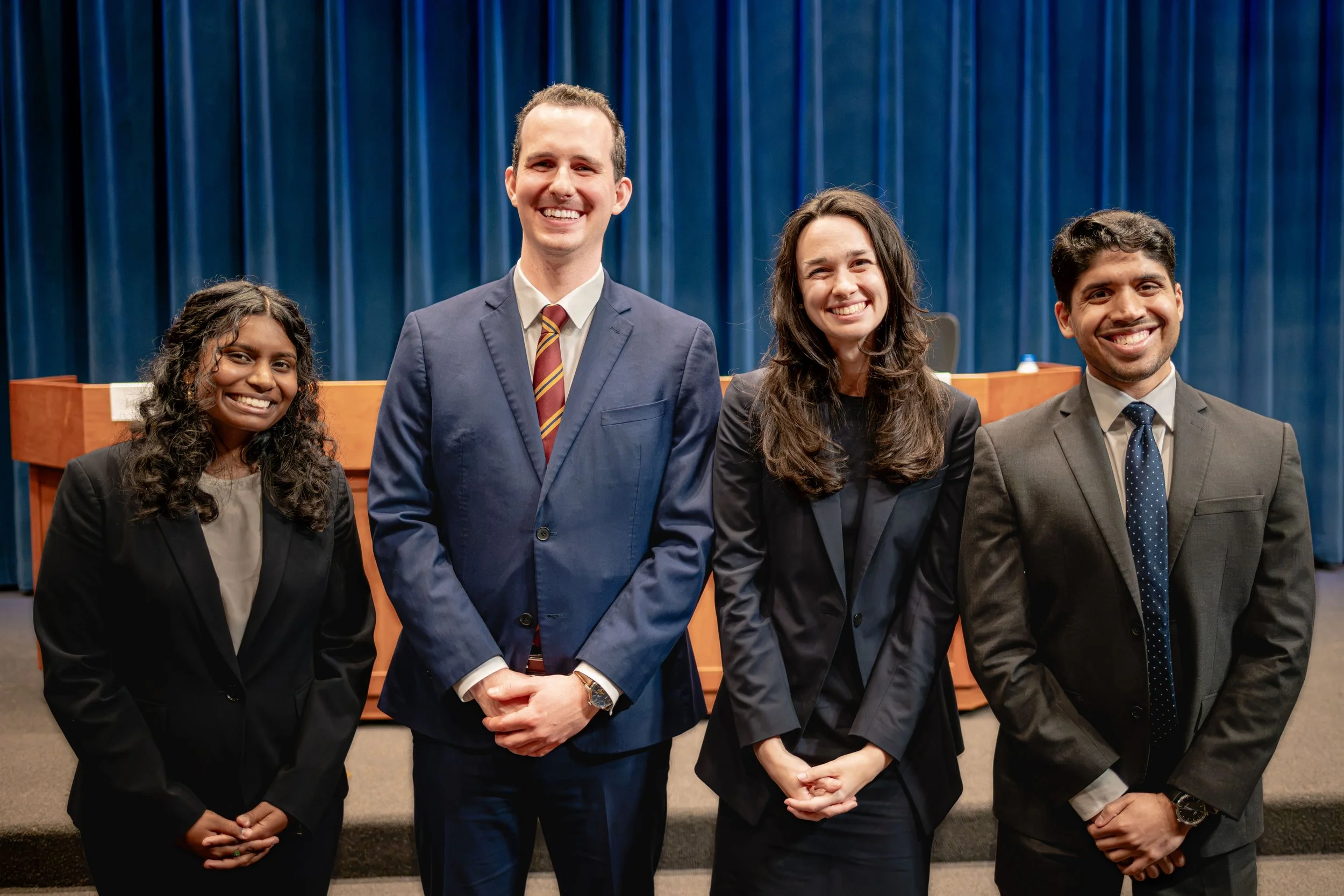
After fifteen minutes, the judges emerged from behind the stage and delivered feedback to the competitors and declared a winner. The judges repeatedly commended the oratory skills of all the competitors, and each expressed that they would be pleased to have the competitors litigating in their respective courtrooms. Judge Berner first noted that it was a very difficult decision for the judges, and announced that Dan Cummins and Shree Balaji were the winners of the 98th Annual Lile William Minor Lile Moot Court Competition. Judge Berner subsequently awarded the Best Advocate Award to Caroline Davisson.
Source: Benvin Lozada
Author: Samuel Koeppel (bjp4zx)