
The Sheep is My Shepherd
When you first think about all the thought and care that goes into the UVA Law community, you might think of organizations like SBA, Student Affairs, and our various affinity groups. But did you know we also have our very own Art Committee? As you may have noticed from the newly vacant walls and painter’s tape, it has been hard at work curating the latest hallway vibes for us all to enjoy.
The Art Committee is composed of Law School faculty and staff, and its role is to advise the Dean about the acquisition, removal, placement, and conservation of artwork. Professor Andrew Hayashi is currently the head of the Committee and has served on it for about four years. He wrote that “the committee is guided by the belief that our physical space is formative of us as whole persons, and we look for works that are sophisticated, beautiful, and curious. We want our art to provoke imaginative conversations and open minds to new perspectives, and we also hope that it will stimulate an interest in art that members of our community will take with them, as travelers, patrons, or collectors.”
All the acquisitions are carefully selected from donations from collectors and galleries. Our collection currently boasts “portraits that celebrate those who have contributed to the life of the Law School, abstract works that provoke emotions and imagination, and more representational works that remind us of our beautiful home in Central Virginia.”
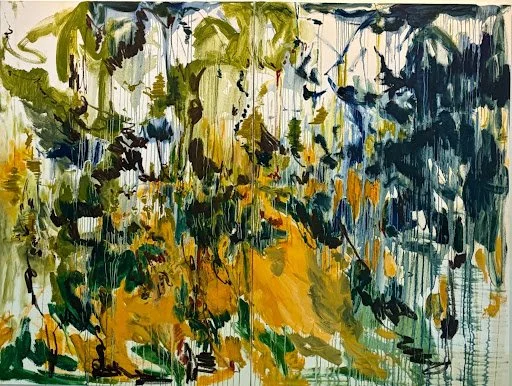
Photo Credit: Author
Among the new pieces on display is Professor Hayashi’s favorite: a diptych oil painting called Autumn Maples by Heather Bause Rubinstein, which now hangs by Caplin Auditorium. Bause Rubinstein told the Law Weekly: “Autumn Maples was made in my upstate New York studio; it’s an abstract painting, but I was literally looking outside my studio window and painted the green that leads up to the forest behind my Catskills home. One of my professors once said ‘paint what you know,’ and I’ve kind of made that my mantra.” She often enjoys straddling the line between abstraction and figuration, while capturing “the political implications of painting the changing climate we are all experiencing.”
But the Committee’s work is not limited to selecting new pieces. It is also planning to create a page on the UVA Law website where students, faculty, and visitors can learn more about the art on our walls. And, perhaps most significantly, the Committee has also welcomed student feedback about the art already in our halls–something that has become particularly noteworthy in the case of the missing Sheep Painting.
The inspiration for this article actually began with the mild uproar–and perhaps genuine outrage–over the absence of the much-beloved 2003 painting entitled Follow the Leader by local Charlottesville artist John Borden Evans, colloquially known as “The Sheep Painting.” Almost all of my friends noticed its absence and expressed disappointment, and everyone else I mentioned it to seemed similarly shocked. It is certainly a favorite of many in the community, including one of UVA’s security officers who thoughtfully remarked that sheep always have a shepherd and do not lead themselves. So who is the shepherd leading the sheep? And perhaps more importantly, where is the wolf?
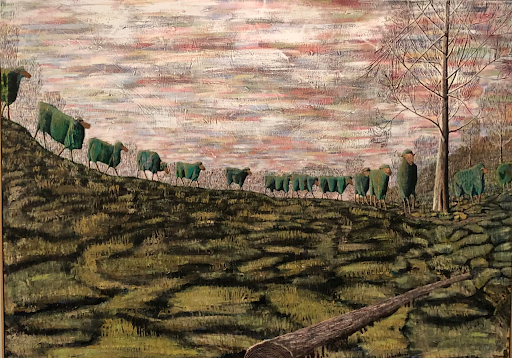
Photo Credit: Author
Another student even expressed how looking at the sheep after class helped calm her rage after Contracts. For the more simple-minded sheep such as myself, I just like them because they are sheep.
But fear not! According to sources familiar with the matter, the Art Committee is in contact with SBA about putting the Sheep Painting back up, and may be seeking student input and potentially even a vote on where to put it next.
While I rejoice at the imminent return of Follow the Leader, perhaps the most gratifying part of this project has been the creation of genuine dialogue and a working relationship between students and the people quietly responsible for the art we have taken for granted. Ironically, what began as a somewhat satirical comment about the lack of student input over art has turned into something much more productive, and we look forward to continuing this collaboration. After all, there are many ways to create, including changing the community around us.
Author: Sophie Zane (yjt8nw@virginia.edu)